
At some point in the first days, someone will hand you a date. Not a suggestion — a date. You'll feel better in three weeks. Or: if they were coming back, it would happen by week three. Either way, the calendar suddenly has a circle around a day that is supposed to change everything. And when that day arrives and you still feel hollow, the quiet conclusion the date leaves you with is that something is wrong with you.
The three-week rule deserves more scrutiny than it gets, because unlike most breakup folklore, this one has a birth certificate. It began as one person's story — a real, specific, moving story — and the person who wrote it later stood in front of it and publicly doubted her own conclusion. The rest of the internet kept the conclusion and dropped the doubt.
This article traces where the 3-week rule came from, what the research on habit formation and recovery actually says about day 21, and what the date is genuinely good for — because it can be useful, just not in the way it's sold.
Key takeaways
- The viral "three-week rule of breakups" began as a single personal essay by writer Esther Wilding on Medium, describing a dramatic shift at exactly 21 days after ending her four-year relationship — and she later published a follow-up questioning her own theory, noting she had initiated the breakup in every case where she experienced the shift [1].
- The "21 days" pattern has an older root: plastic surgeon Maxwell Maltz's observation in Psycho-Cybernetics (1960) that patients took about three weeks to adjust to their new reflection after surgery — the origin of the "21 days to form a habit" legend [2].
- The empirical habit-formation data contradict the round number: in the landmark Lally study, the median time to habit automaticity was 66 days, with a range of 18–254 days — and even "66 days" carries caveats about who it describes [3][4].
- Week three after a breakup is real progress but very early progress. Acute distress declines across five months in the data, and people consistently overestimate how much the first weeks will heal them [5].
- Reconciliation is common but follows no 3-week clock: roughly 45% of young adults report at least one breakup-reconciliation, the average person who reconciles does so more than twice, and what predicts renewals is uncertainty and not dating others — not timing [6][7].
- The honest version: use day 21 as a checkpoint, not a deadline. If you're still hurting at three weeks, that's the data's expectation, not a personal failure [5][8].
In this guide
1. What the 3-week rule actually claims
The three-week rule isn't one claim; it's a small family of them, and they get blended together:
"You'll be over it in 21 days." The recovery claim: three weeks is roughly how long acute heartbreak lasts, so mark the calendar and expect relief.
"Three weeks of no contact is enough to reset." The behavior claim: commit to 21 consecutive days of no contact, and something fundamental shifts in the dynamic — popular in no-contact coaching content and on social media [1].
"If they were coming back, it would happen by then." The reconciliation claim: three weeks is the window in which an ex who will return does return — so if the date passes silently, let go.
These three claims are different statements about different things, and none is supported by research. But they share an emotional logic that is easy to fall into: the uncertainty has an endpoint, and the endpoint is soon. That's the actual product being sold, and it's why the rule travels so well.
2. Where it came from
Unlike the 72-hour rule, which has no clear parent, the three-week rule of breakups has a documented origin — and it's worth reading carefully, because the story is more honest than the rule it produced.
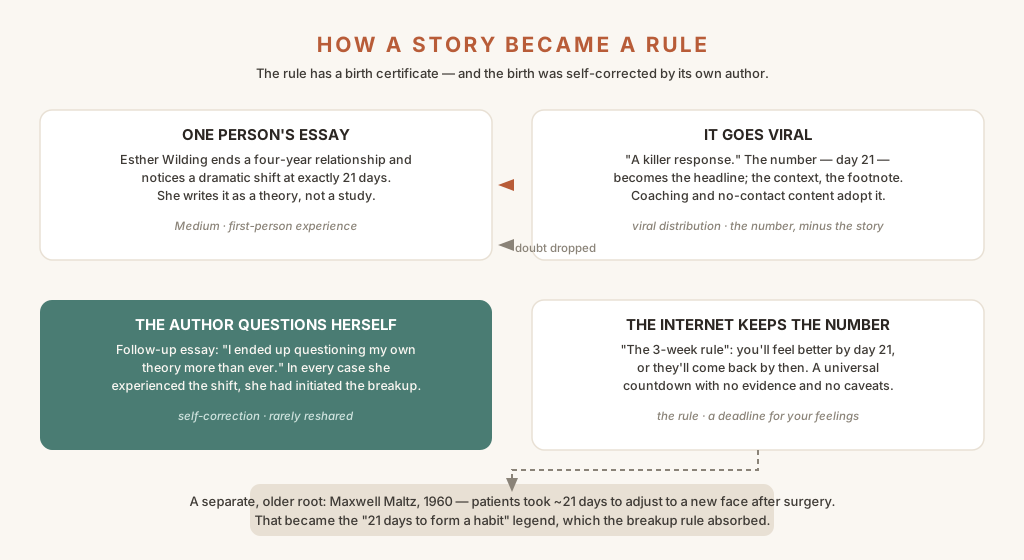
In a Medium essay, the writer Esther Wilding described ending a four-year relationship and then experiencing what she called a drastic change — of outlook, attitude, and overall well-being — at almost exactly 21 days afterward. She wrote it as a theory, not a study: a pattern she noticed in herself, shared in the hope that it might help other people put an expiry date on their misery [1].
The essay went viral. Wilding describes getting a "killer response." And then something rare and admirable happened: she wrote a follow-up and publicly walked parts of it back. Reviewing the feedback and comments, she said, she ended up questioning her own theory more than ever. Her most important caveat: in every scenario where she experienced the "three-week transformation," she had initiated the breakup. She was not the person on the receiving end — she was the person who chose the ending and had been processing it for weeks before the official words were spoken [1].
So the viral rule's origin is: one person's genuine experience, of a specific kind of breakup, self-corrected by its author, and then flattened back into a universal countdown by the internet that shared it.
The "21 days" number also has a deeper, unrelated root that predates the breakup world entirely. In 1960, the plastic surgeon Maxwell Maltz published Psycho-Cybernetics, in which he noted that his patients took roughly 21 days to get used to their new reflection after facial surgery. That observation — about adjusting to a changed face, not about forming habits or healing hearts — became the source of the "21 days to form a habit" claim repeated everywhere since [2]. Three weeks was a number about mirrors before it was a number about breakups.
3. What the research says about 21 days
If the "21 days" claim is really a habit-formation claim underneath — three weeks to reset a pattern — then it has been tested. The results are not kind to the number.
The landmark study is Lally et al. (2010), which tracked 96 people attempting to establish a simple daily behavior (a glass of water after breakfast, a short walk) and asked them daily how automatic the behavior felt. The researchers found that habit automaticity developed on an asymptotic curve, and the median time to reach it was 66 days — not 21 [3]. The range matters even more than the median: across individuals, the time to habit formation ran from 18 to 254 days. The slowest habit-formers took fourteen times longer than the fastest [4].
And even "66 days" needs its own caveat, because the finding is more fragile than the meme: it's the median of the roughly half of participants whose modeled time-to-automaticity fell inside the 84-day observation window. For the slower participants, the number is a statistical projection beyond what was actually observed [4].
What does this mean for the 3-week rule? The habit-forming version of the claim — 21 days to reset the pattern of them — is contradicted by the best data we have on how long automaticity actually takes. The median is three times the rule, and the spread is enormous. If "three weeks to rewire the habit of a person" were true, it would be the fastest-rewarding behavioral change in the literature. It isn't.
Searches for the rule surface essays and coaching content — our timeline research found no peer-reviewed study of a three-week breakup recovery rule [8].
| The 3-week claim | What the research actually shows |
|---|---|
| "21 days resets a habit" | Median 66 days to automaticity; range 18–254 days (N=96) [3][4] |
| "You'll feel better by week three" | Distress falls 30.42 → 24.15 → 20.69 across months 1–5 — week three is inside month one [5] |
| "They'll come back by day 21" | ~45% of young adults reconcile, averaging ~2.4 disruptions; renewals follow uncertainty, not timing [6][7] |
4. What actually happens around week three
None of this means week three is meaningless. It just means the honest picture is more interesting than a deadline.
The recovery data from our timeline research describes two clocks. The acute-distress clock — the heaviness, the replaying, the physical symptoms — declines steadily but on the scale of months, not weeks: in a 2020 study of recently separated adults, distress fell from 30.42 in month one to 24.15 in month three to 20.69 in month five [5]. Week three sits inside month one — the beginning of the decline, not the end of it.
The second finding explains why day 21 so often disappoints: people systematically overestimate how much the first weeks will heal them — the error concentrated right at the start [5]. So the person who circles day 21 isn't just hoping; they're repeating a documented forecasting bias. Their expectation that "I should feel much better by now" is a prediction error, not a failing.
And a slower clock runs underneath: the attachment bond to an ex fades on a scale of years — its measured half-life is about four — while breakup language normalizes within about six months [9]. Week three is early on both clocks. Feeling heavy at three weeks is the data's expectation. The person who feels dramatically better at exactly day 21 exists — that's how the rule was born — but they're the exception the essay described, not the rule its title created.
Prefer to read it first? See what's inside the guide.
5. Will they come back? The reconciliation data
The third version of the 3-week rule — the reconciliation window — is the one doing the most quiet damage, so it deserves the research directly.
Reconciliation is real and common: in a national study of young adults, roughly 45% reported at least one breakup and reconciliation with their current or most recent partner [6]. If you're hoping they'll come back, you're not delusional — you're in a large statistical group.
But the pattern is not a window; it's a cycle. Among people who had reconciled, the average number of disruptions was about 2.4 — reconciliation, where it happens, is rarely a one-time event. The research literature calls this "relationship churning": break up, get back together, break up again [6]. The people holding the three-week hope usually imagine a single clean return; the data describe a loop that can take months or years and often repeats.
What actually predicts a renewal is even less romantic: in the on-again/off-again research, renewals were predicted by uncertainty about what the breakup meant, not having dated anyone else, and feeling that the on-off nature had improved the relationship — not by a timing window [7]. The ex who "comes back in three weeks" is, in the data, usually an ex who was uncertain and uninfluenced — and the return, when it comes, is more often part of a cycle than a resolution.
This is the harshest but most useful finding for the person reading this: the hope pinned to day 21 is hope pinned to a number that has nothing to do with whether they return. The uncertainty you're trying to end with a calendar date doesn't end on a calendar date [6][7].
6. Why a number is so seductive
It's worth pausing on why the rule spreads — understanding the pull is part of using it honestly.
A breakup is a period of radical uncertainty — about the relationship, about yourself, about the future. Uncertainty is one of the most aversive states a human brain produces, and the brain's first instinct is not to tolerate it but to compress it: to find or invent an endpoint. A date is the perfect compression. Day 21. Now the horror has a shape and a schedule. The calendar becomes a proxy for control.
The cost of this comfort is hidden: when you assign a number to a feeling, you also assign yourself a deadline to feel better. The person who circles day 21 isn't just marking hope — they're setting a trap. When the date passes and the feeling hasn't, the rule's logic converts "this still hurts" into "I'm failing at healing." The number that was supposed to remove the uncertainty becomes a new instrument of self-judgment.
The research points to the opposite direction: healing has a shape, not a schedule. The two clocks — acute distress over months, attachment over years — describe where people actually are, and neither clock reads in three-week increments [5][9]. A calendar is a fine place to track days. It's a terrible place to track feelings.
7. The honest version: a checkpoint, not a deadline
So what is day 21 actually good for?
Use it as a checkpoint, not a verdict. Three weeks is a reasonable first interval to check in: how is the acute heaviness trending? Not "have I healed" — "is the decline happening?" The data say the decline exists by then, but it's a trend, not a finish line [5].
Expect to still hurt at week three — that's normal. If you were handed the rule by a well-meaning friend, you can hand them this back: the recovery research expects you to still be heavy at three weeks, and the people who feel dramatically better by then are the exception, not the standard [5][9].
Drop the reconciliation countdown. The research on who returns has nothing to do with timing — it's about uncertainty, alternatives, and the pattern of the relationship itself [6][7]. Watching a calendar for a return is a way of staying on the hook for a question the calendar can't answer.
If you want a number, use the real ones. The recovery curves we built into the Breakup Timeline Calculator show where the weeks actually land: acute distress declining across five months, language patterns normalizing around six, the bond half-life around four years [5][9]. Those are the honest intervals — and they're all longer than three weeks, which is precisely the point.
And if the heaviness isn't declining — if you're in deep distress at the six-month mark, still preoccupied, still defining yourself by the relationship — that's the real marker to act on, and it's a good reason to seek professional help [9]. Not because you failed a three-week deadline, but because the trend itself is the signal.
And if you're in crisis — struggling with thoughts of self-harm or feeling unsafe — that's not a rule situation, it's a crisis situation. In the US, call or text 988 (Suicide & Crisis Lifeline), or contact your local emergency services. A countdown is for normal heartbreak. This is different.
FAQ
What is the 3-week rule of breakups?
It's a viral claim that you'll feel dramatically better 21 days after a breakup — or that your ex will return within that window. It began as one person's Medium essay describing her own experience at exactly 21 days, and the author later publicly questioned her own theory [1]. No peer-reviewed study supports a three-week recovery or reconciliation rule [8].
Does the 3-week rule actually work?
The number doesn't. The habit-formation research it leans on found a median of 66 days to automaticity with a range of 18–254 days [3][4], and the recovery data show acute distress declining over months, not resolving in weeks [5]. Some people do feel dramatically better at three weeks — that's how the rule was born — but it's an exception, not a standard.
Where did the 3-week rule come from?
From writer Esther Wilding's viral Medium essay about ending her four-year relationship and feeling transformed at exactly 21 days — which she later partially walked back, noting she had initiated the breakup in every case where she experienced it [1]. The "21 days" figure also echoes plastic surgeon Maxwell Maltz's 1960 observation about patients adjusting to their post-surgery reflection [2].
Is it normal to still feel terrible after 3 weeks?
Yes. It's the data's expectation. Acute distress declines steadily across five months in the recovery research, and people consistently overestimate how much the first weeks will heal them — so still hurting at week three is normal, not a failure [5].
Will my ex come back after 3 weeks?
No timing rule predicts reconciliation. Roughly 45% of young adults experience at least one breakup-reconciliation, but it follows no 3-week clock — the average person who reconciles does so more than twice, and what predicts renewals is uncertainty and not dating others, not timing [6][7].
Is the 3-week rule the same as 21 days of no contact?
Related but different. The no-contact version tells you to commit to 21 consecutive days without contact. There's no evidence 21 days is special for contact dynamics either — the habit research suggests pattern-change takes longer and varies hugely between people [3][4].
Conclusion: the honest version
The three-week rule is a story that got promoted to a law. The story is real — someone felt a dramatic shift at day 21, wrote it down beautifully, and then told the world it might not generalize. The law is the part everyone kept: a number that promises the uncertainty will end soon, and quietly makes you the problem when it doesn't.
Here's what's actually true: you're not on a three-week schedule, and you never were. The heaviness you're feeling runs on a clock measured in months, the pull toward them on a clock measured in years, and neither one cares about the date you circled [5][9]. What the research offers instead of a deadline is a trend — a direction, a decline, a shape you can check on without grading yourself against it.
The five stages are folklore the same way this rule is. The honest timeline is longer than any number the internet hands you — and that's the good news, because a timeline you can actually live in is more useful than a deadline you'll fail. The honest 90-day plan walks through what the real weeks look like, and the 72-hour pause is the sibling myth to this one — both are pauses sold as magic.
Feel better at three weeks? Wonderful — that's the exception, and it's real. Still heavy at three weeks? Also real, also normal, and it says nothing about you except that your healing runs on its own clock. The date was never the point. The point was always that the decline is happening — even on the days the calendar can't see it.
Sources
- Wilding, E. "The Three-Week Rule of Breakups" and "The Three-Week Rule of Breakups — Part Two," Medium. — Essay + Part Two — first-person anecdote; describes the 21-day shift, the "killer response," and her own later questioning of the theory (including that she initiated the breakups in her experiences). Characterized from her published text and her Medium profile, accessed 2026-08-24.
- Maxwell Maltz, Psycho-Cybernetics (1960) — the 21-day observation about patients adjusting to their post-surgery reflection, origin of the "21 days to form a habit" legend. UCL habit-myth blog + Mentalzon summary, accessed 2026-08-24 (secondary; the book itself not read directly).
- Lally, P., van Jaarsveld, C. H. M., Potts, H. W. W., & Wardle, J. (2010). How are habits formed: Modelling habit formation in the real world. European Journal of Social Psychology, 40(6), 998–1009. — UCL Health Behaviour Research Centre blog (read directly 2026-08-24; the paper itself paywalled).
- Hreha, J. How long does it take to form a habit? What Lally et al. (2010) actually found. The Behavioral Scientist. — Close reading (read directly 2026-08-24; provides the median 66 days, 18–254 day range, and the ~48%-within-window caveat).
- O'Hara, K. L., et al. (2020). Clinical Psychological Science. — Separation distress declined 30.42 → 24.15 → 20.69 across five months. Full text, PubMed Central (read directly during our timeline article production, 2026-08-24). Eastwick, P. W., et al. (2008). Journal of Experimental Social Psychology, 44(3), 800–807. — Author manuscript (people overestimate early recovery; error concentrated at the start).
- Halpern-Meekin, S., Manning, W. D., Giordano, P. C., & Longmore, M. A. Relationship churning in emerging adulthood: On/off relationships and sex with an ex. — Full text, PubMed Central — ~45% of young adults report a reconciliation; average ~2.4 disruptions among those who reconciled (read directly 2026-08-24).
- Dailey, R. M., Jin, B., Pfiester, A., & Beck, G. (2011). On-again/off-again dating relationships: What keeps partners coming back? The Journal of Social Psychology, 151(4), 417–440. — PDF abstract — renewals predicted by uncertainty, not dating others, and perceived improvement (read directly 2026-08-24).
- Our timeline article (2026-08-24): searches for "the three-week rule" surface social-media and coaching content; no peer-reviewed study of a three-week breakup rule was found. How long does it take to get over a breakup?
- Chong, S. C., & Fraley, R. C. (2025). Social Psychological and Personality Science. — Attachment bond half-life ~4 years (midpoint 4.18 years); abstract + authors' summary read directly during our timeline production. Seraj, S., Blackburn, K. G., & Pennebaker, J. W. (2021). PNAS. — breakup language normalizes ~6 months; deep distress at 6 months–1 year → professional help; authors' summary read directly during our timeline production.
Methodology
How this was compiled. This article was researched and written on 2026-08-24. The origin claim (Source 1) is based on Esther Wilding's two Medium essays — the original and her follow-up, in which she questions her own theory — read via search results and her published text; it is a first-person anecdote and is labeled as such in the article. The habit-formation claims (Sources 3–4) were verified against the UCL Health Behaviour Research Centre's summary of the Lally study and The Behavioral Scientist's close reading; the Lally paper itself is paywalled, so the numbers are attributed with that access level stated. The recovery and reconciliation claims (Sources 5–6, 9) were verified in full — PMC full texts and author manuscripts read directly, in this production or during our timeline article. The Dailey renewals claim (Source 7) is from the paper's published abstract.
What is not claimed. We are not claiming the 3-week rule has no value as a checkpoint — it does. We are claiming the number has no research basis, which is the finding. We are not claiming reconciliation never happens at three weeks; we are claiming no timing rule predicts it, which the cycling research supports. We are not claiming everyone takes 66 days to form habits — the range is the point. No first-hand clinical experience is claimed; the author is an editorial lead, not a therapist. If you are in crisis, call or text 988 (US) or your local emergency services.
Update schedule. Reviewed monthly against the cited research, consistent with the site's freshness policy for recovery content.