
There's a specific hour in a breakup when the rule stops being a rule and becomes a negotiation. It's usually late — after the last message you didn't send, after the third time you checked their profile. The phone is warm in your hand. You have a sentence half-typed, or a question you tell yourself is neutral, or a picture you could like "accidentally." And somewhere in the back of your head, the no-contact rule — the most repeated breakup advice on the internet — is whispering a number. Thirty days. Sixty. Ninety. If you break it, you start over.
This article is about what that rule actually is: what it claims, where the numbers came from, and what the research does and doesn't support. Because the honest version is stranger and more useful than the countdown version. The number is folklore. The mechanism — the thing the rule is clumsily pointing at — is one of the better-supported findings in the breakup literature.
Here's the short version. No contact doesn't work because thirty days is a magic number. It works because exposure to an ex keeps the wound open: in the studies, contact predicts more distress later, and watching their life predicts more distress the next day [1][3][4]. The rule is a way to stop the exposure. The countdown is just the container coaches put it in. And once you see that, "does liking a post count?" stops being a rule question and becomes another one entirely: what am I feeding?
Key takeaways
- The "30/60/90-day" numbers have no research basis. We found no peer-reviewed study establishing any specific duration; the numbers circulate in coaching and app content, and coaches themselves call the 30-day rule folklore whose origin nobody can pin down [9].
- What the research does support is the mechanism: contact with an ex is associated with slower recovery. In a longitudinal study of 122 separated adults, more in-person contact predicted higher distress two months later — offsetting about 112% of the normal two-month decline (for people without shared children) [1]. In a 28-day diary study, contact slowed the natural decline of love and sadness [2].
- Watching them is contact too. Facebook surveillance of an ex predicted greater distress, longing, and lower personal growth [3], and a 2025 four-study series found active observation predicted greater same-day and next-day distress — its authors recommend unfriending, unfollowing, or muting [4].
- The urge is not weakness. Recently rejected people spent more than 85% of their waking hours thinking about the ex, on average 63 days after the rejection, with brain regions tied to reward and craving lighting up [5]. The attachment bond behind it has a half-life of about four years [6].
- No contact will not make them come back — nothing does, on a schedule. Reconciliation follows no timing rule; what predicts renewals is uncertainty and not dating others, not elapsed days [10][11].
- Keeping the boundary works better with if-then plans than with pure willpower or suppression: "when I want to text them, I will do X instead." Plans for stopping a behavior need a specific substitute action [8], and suppressing thoughts of an old flame can actually strengthen them [8].
In this guide
- 1. What the no-contact rule claims
- 2. Where the numbers came from
- 3. What the research supports: exposure slows recovery
- 4. The exception: kids, co-parenting, and unavoidable contact
- 5. Why the urge feels physical
- 6. Will no contact make them come back?
- 7. What counts as breaking no contact
- 8. The terms people actually use
- 9. Breadcrumbing: when they break the boundary for you
- 10. How to actually keep it
- FAQ
- Conclusion: the honest version
1. What the no-contact rule claims
The rule, as it circulates, is simple: after a breakup, stop all contact with your ex for a set period — most commonly thirty days, sometimes sixty or ninety — and don't restart the clock if you slip. Some versions add a social-media component: no liking, no viewing stories, no checking. Some versions add a purpose: it will make them miss you, realize what they lost, and come back.
That distinction matters, because two very different things wear the same name. The boundary version says: no contact is space you take for your own recovery — you stop the exposure so the wound can close. The tactic version says: no contact is a move that changes their feelings — absence makes them reconsider. The first depends only on you. The second depends on them responding the way you hope.
The research we found speaks to the first version. It has essentially nothing to say about the second — except, as you'll see, that waiting on a schedule is the wrong frame entirely [10][11].
2. Where the numbers came from
Nobody is sure where "30 days" came from, and the coaches who repeat it can't cite a study — the most honest say so: one wrote that the rule "has no concrete studies backing up its effectiveness," another that the number is "entrenched in the culture," and the Attachment Project that "there's no psychological research suggesting that 30 days is the ideal time period" [9].
This is a negative finding, and we want to be careful how we state it: absence of evidence is not proof the number is harmful. A defined period has real value as a behavior container — it stops you from renegotiating the boundary every evening [8]. But the number isn't doing the work; the container is. If you treat thirty days as the cure, then day thirty-one — when you still miss them, still check, still feel hollow — becomes a second failure on top of the first. The number is scaffolding, not medicine. (For the same pattern in the breakup-folklore family, see our articles on the 72-hour rule and the 3-week rule.)
3. What the research supports: exposure slows recovery
The mechanism under the rule has real evidence behind it. In a longitudinal study of 122 recently separated adults, researchers used an ambient recording device that samples sound across the day — sidestepping people's often-inaccurate self-reports. More in-person contact predicted higher separation-related distress two months later, after accounting for attachment, relationship history, and other factors. For adults without shared children, a one-standard-deviation increase in contact offset about 112% of the two-month decline in distress — not a little friction; it largely stopped the recovery clock for that group [1].
The finding repeats across methods:
| Study | Method | What it found |
|---|---|---|
| Sbarra & Emery 2005 [2] | 28-day beeper diary, N=58 | Contact with the ex slowed the decline of love and sadness |
| O'Hara et al. 2020 [1] | Longitudinal + ambient recording, N=122 | In-person contact predicted higher distress 2 months later (adults without children) |
| Marshall 2012 [3] | Survey, N=464 | Facebook surveillance associated with greater distress, longing, lower personal growth |
| Marshall 2025 [4] | 4 studies, N=762, incl. daily diary | Active observation → greater same-day and next-day distress; passive observation → same-day negative affect |
Two patterns are worth noticing. First, the findings get more specific over time: love and sadness in 2005, distress two months out in 2020, and — in the daily-diary 2025 studies — the same day and the next day. Watching them today makes tomorrow measurably worse [4]. Second, the effect holds even for passive observation, where you're just scrolling and happening to see them [4]. That's why "does a like count?" is the wrong question. It's not the like. It's the exposure.
4. The exception: kids, co-parenting, and unavoidable contact
The O'Hara finding carried a boundary: the contact effect appeared for adults without shared children. When kids are in the picture, contact isn't optional, and the research doesn't show the same pattern [1]. No contact, as usually described, isn't available to co-parents — going cold isn't a boundary, it's a different stress on an already hard situation.
The honest version for co-parents is narrower: you can't stop exposure, so the work shifts to making contact functional. Keep it logistical — schedules, drop-offs, the practical mechanics — and treat emotional exchanges as out of scope. The same research explains why this is hard: the exposure that slows recovery isn't just in-person; it's the checking, the rereading, the hoping that ride on top of any contact, even necessary contact. (This deserves its own guide — it's on our roadmap.)
5. Why the urge feels physical
Here's the part that makes this feel like a personal failure, and it isn't. In an fMRI study of rejected people, participants spent more than 85% of their waking hours thinking about the ex — on average, 63 days after the rejection. Photos of the ex activated brain regions involved in motivation, reward, and craving, alongside regions involved in physical pain; the researchers described the pattern in terms that sound like withdrawal [5].
And the urge sits on an even slower process: the attachment bond to an ex has a half-life of about four years [6]. That doesn't mean you'll ache for four years — acute pain declines on its own schedule, weeks to months for most people [1][7]. It means the background bond fades over years, and contact keeps feeding it. When you feel the 1am pull, you're not failing a rule; you're feeling a bond doing what bonds do when they're still fed. The timeline article walks through these two clocks in detail, and our breakup timeline calculator shows where you are on each.
Prefer to read it first? See what's inside the guide.
6. Will no contact make them come back?
This is the question behind a lot of the countdown anxiety, so let's be direct: no contact doesn't make someone come back, and nothing else does on a schedule either. The reconciliation research finds no timing rule. Renewals are common — roughly 45% of young adults report at least one — and the average person who reconciles does so more than twice [10]. But what predicts a renewal isn't elapsed days or strategic silence; it's uncertainty about what the breakup meant, and not having dated others [11]. Timing is not in the model.
The tactic version — the countdown-to-reunion — is built on a mechanism the data don't support. If reconciliation happens, it happens on the messy logic of two specific people, not a calendar. The boundary version doesn't depend on that outcome at all, which is why you can actually hold it: it works whether they come back or never think of you again, because its purpose is your recovery, not their response.
7. What counts as breaking no contact
The popular version treats this as a list: no texts, no calls, no likes, no "accidental" story views. The research suggests a better way to draw the line — a question rather than a list:
Did you reach out to them? (direct contact)
No — did you deliberately look at them? (monitoring)
No — did you learn about them secondhand? (indirect exposure)
All three feed the same process. Direct contact is the most obvious version, and the one the studies measure most directly [1][2]. Monitoring is the sneaky one — and the data say it's not neutral: surveillance predicts more distress and longing [3], and the daily-diary studies found the same-day and next-day cost of both active and passive observation [4]. Indirect exposure — checking a mutual friend's page to see if they're in the photos, scrolling a shared playlist — is the same exposure wearing a coat. It's still them, arriving in your attention uninvited, and it still feeds the bond.
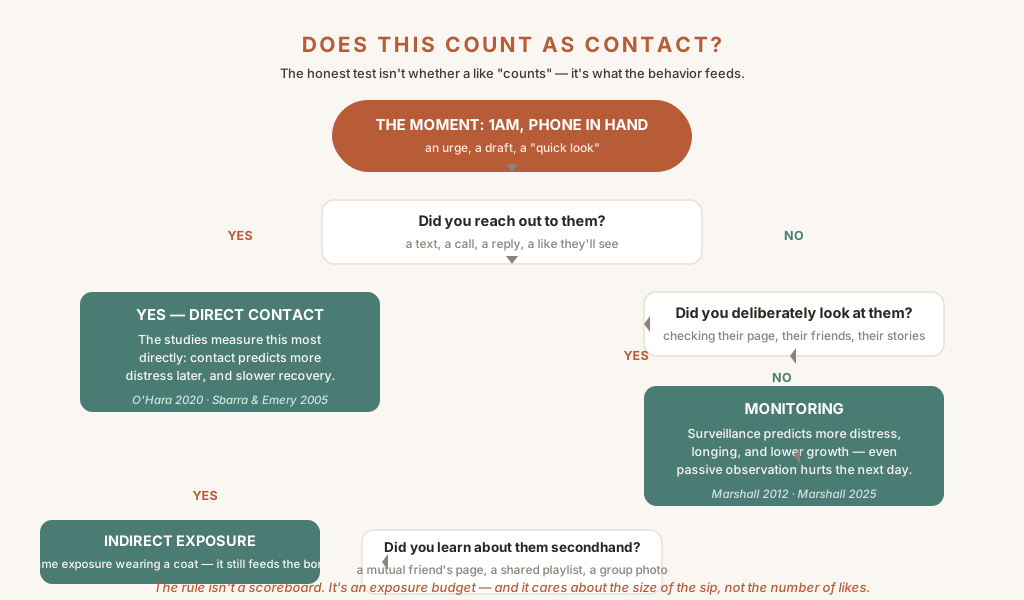
That's why "does liking a post count?" gets a genuinely useful answer: not "yes, and the clock restarts," but "if you have to ask, you already know what it feeds." The rule isn't a scoreboard; it's an exposure budget. And an exposure budget doesn't care about the number of likes — it cares about the size of the sip.
8. The terms people actually use
A lot of the language around this rule is the same idea wearing different labels, and the differences mostly don't survive contact with the research. If you arrived here from one of these searches, this is the short version.
"No contact policy" and "zero contact" are the same thing as the no-contact rule: a deliberate decision to stop all direct contact and all monitoring. "Policy" is the framing you'd use with yourself — it's a rule you set in advance rather than a feeling you renegotiate each evening. "Zero contact" is the absolute version, and it's worth knowing that the research doesn't require zero in the literal sense; it requires stopping exposure. A shared child, a shared lease, or a shared employer means zero isn't available, and the honest version becomes "logistical only."
"No contact period" usually means the duration, not a menstrual or contractual period — "how long is the no contact period." The research answer is that the mechanism is well-supported and the number is not: exposure to an ex predicts more distress that day and the next [4], and stopping exposure is what the evidence supports, but no study establishes an ideal duration [1][9]. Treating it as a fixed sentence is where people get hurt — day thirty-one arrives, the missing hasn't stopped, and the number you were promised becomes a second failure. The container helps; the number is scaffolding, not medicine.
"What is no contact" — the definition, plainly: you stop contacting them and you stop consuming information about them. Most people get the first half and miss the second. Monitoring — checking a story, a profile, a shared playlist — is still exposure, and the daily-diary data show it carries the same-day and next-day cost as direct contact [3][4]. That's why "I'm not texting them, I'm just looking" doesn't get you out of the mechanism.
Why the numbers vary so much. If you've seen 21 days, 30 days, 60 days, or 90 days all presented as the answer, that range is itself the finding: they come from different folklore traditions, not different studies, and none of them is derived from evidence about recovery [9]. Our 3-week rule article traces where the 21-day version came from — it started as one person's self-corrected estimate, not a clinical finding — and the 72-hour rule article does the same for the 72-hour version. The pattern is the same in both cases: a real psychological mechanism gets attached to an invented number.
The short version: if a duration is being sold to you as the point, the mechanism has been replaced with a countdown. Use any duration you like as a container — and judge success by whether exposure actually stopped, not whether you reached a date.
9. Breadcrumbing: when they break the boundary for you
The boundary has a second door, and it's the one you didn't open. Breadcrumbing — intermittent, non-committal signals after a breakup: a "hope you're okay" at a random hour, a like on an old photo — is contact arriving from their side. A 2023 qualitative study found a consistent pattern: mixed signals and false hope, with the receiver left confused and drained; every participant reported trust problems in later relationships, and the most-cited coping path was therapy and self-work [12]. An earlier survey found breadcrumbing associated with lower life satisfaction and more loneliness [12].
Breadcrumbing works on you only if you're still receiving — the signal needs a receiver. The honest response isn't to decode whether it means something (the researchers' own framing is that it's defined by not meaning something); it's to decide, in advance, that a breadcrumb is not information about your future. It's noise from the boundary's other side. (If you're weighing blocking, our 72-hour rule article covers the research on impulsive responses to contact.)
10. How to actually keep it
The countdown model tells you to resist the urge daily and feel bad about each slip. The research suggests a different engine: don't rely on willpower; build the decision in advance (for the thought loop specifically, see our guide on how to stop thinking about your ex). (For the full arc across the first ninety days, the honest 90-day plan is the pillar guide.)
Make if-then plans, not promises. Implementation intentions — "if X happens, then I will do Y" — show a medium-to-large effect on follow-through across more than 8,000 participants [8]. The catch: plans for stopping a behavior work less well than plans for starting one, unless the substitute is specific: "when I want to text them, I will text [friend] instead" beats "when I want to text them, I won't" [8].
Don't try to suppress the thought. The classic study on suppressing thoughts of an old flame is titled, accurately, "Fanning old flames": pushing the thought away tends to strengthen its return [8]. The urge is allowed to exist; the behavior isn't. That distinction — feel it, don't act on it — is the whole game, and it's why the plan matters more than the resolve.
Remove the exposure at the source. The 2025 studies' authors say it plainly: unfriend, unfollow, or mute [4]. This isn't a punishment you inflict on them — it's a settings change on your own feed. If blocking feels aggressive, mute first; the goal is that their life stops arriving uninvited.
Anchor to the two clocks. "I should be over this by now" is corrosive because it compares the wrong clocks. Acute distress declines over weeks to months [1][7]; the attachment bond fades over years [6]. Feeling the pull at month two is the data's expectation, not your failure — and the calculator shows which clock you're actually feeling.
When the plan is bigger than one night. If the urge is relentless — breaking the boundary every few days, or checking as the main event of your evenings — that's not a willpower shortage. The slow-recovery research points to a professional hand: deep distress six months to a year after the breakup is a good time to seek help [7]. No article, including this one, replaces that.
FAQ
How long should no contact last?
There's no evidence-backed number — the research supports the mechanism (stopping exposure), not a duration. A practical frame: long enough for the urge to stop running your evenings, which for acute distress is typically weeks to months [1][9]. If you're early in the process, the First 7 Days plan structures that first week.
Will no contact make my ex come back?
No — no timing rule predicts reconciliation. Renewals are common (roughly 45% of young adults report at least one), but what predicts them is uncertainty about the breakup and not having dated others, not elapsed days [10][11]. No contact is a boundary for your recovery; a reunion tactic builds the whole effort on an outcome you don't control.
Does liking their post break no contact?
If you have to ask, you already know what it feeds. The research doesn't scoreboard the rule — exposure to an ex, including passive observation, predicts more distress the same day and the next [4]. The honest test isn't whether it "counts," but whether it feeds the bond you're trying to let fade.
Should I block my ex on social media?
The 2025 four-study series recommends unfriending, unfollowing, or muting — even passive observation predicts worse same-day feelings [4]. Blocking isn't a punishment toward them; it's a settings change on your own feed. If it feels too aggressive, mute — the goal is that their life stops arriving in your attention uninvited.
How do I stop texting my ex?
Don't rely on willpower — build the decision in advance. If-then plans work: "when I want to text them, I will text [friend] instead" (a specific substitute beats a bare instruction to stop) [8]. And don't suppress the thought itself; suppression strengthens the urge's return [8]. Feel the urge, don't act on it.
What is breadcrumbing?
Intermittent, non-committal signals from an ex after the breakup — a random "hope you're okay," a like on an old photo — that keep you hopeful without any commitment behind them. Research characterizes it as mixed signals and false hope that leave the receiver confused and drained; in one study, every participant who'd been breadcrumbed reported trust problems in later relationships [12]. The honest response is to stop receiving: any message from them means nothing about your future.
What if we have a child together?
Then strict no contact isn't available to you, and the research doesn't expect it — the contact effect appeared for adults without shared children [1]. The honest version is narrower: keep contact logistical and out of emotional scope. It's genuinely harder, and it deserves its own guide.
Conclusion: the honest version
Here's what the rule is, in the end. Not a magic number, and not a move against anyone — not a punishment you inflict on them, not a tactic to make them miss you. It's a boundary you set for your own recovery, and the research says the boundary points the right way: exposure keeps the wound open; stopping it lets the natural process run [1][2][3][4].
So the honest version of the no-contact rule has no countdown. It has a question you ask yourself when the phone is warm in your hand at 1am: what am I feeding? The bond you're trying to let fade gets fed by every text, every look, every accidental glimpse. The person you're becoming gets fed by everything else. That's the whole rule — easier to keep than thirty days, because it never asks you to be strong, only to notice which fire you're feeding.
Sources
- O'Hara, K. L., et al. (2020). Contact with an ex-partner is associated with psychological distress after marital separation. Clinical Psychological Science. — Full text, PubMed Central — N=122, ambient recording across five months; in-person contact predicted higher distress 2 months later for adults without shared children; 1 SD ≈ 112% of normal two-month decline. Read directly 2026-08-24.
- Sbarra, D. A., & Emery, R. E. (2005). The emotional sequelae of nonmarital relationship dissolution. Personal Relationships, 12(2), 213–232. — Publisher abstract — 28-day beeper diary, N=58; contact slowed the decline of love and sadness. Verified during our timeline article production; abstract read directly 2026-08-24.
- Marshall, T. C. (2012). Facebook surveillance of former romantic partners: Associations with postbreakup recovery and personal growth. Cyberpsychology, Behavior, and Social Networking, 15(10), 521–526. — Full text, PubMed Central — N=464; surveillance associated with greater distress, longing, lower growth. Read directly 2026-08-24.
- Marshall, T. C. (2025). Social media observation of ex-partners is associated with greater breakup distress, negative affect, and jealousy. Computers in Human Behavior, 176, 108869 (online 2025; March 2026 issue). — Full text, ScienceDirect — 4 studies, N=762; active and passive observation predict same-day/next-day distress; authors recommend unfriending/unfollowing/muting. Read directly 2026-08-24.
- Fisher, H. E., Brown, L. L., Aron, A., Strong, G., & Mashek, D. (2010). Reward, addiction, and emotion regulation systems associated with rejection in love. Journal of Neurophysiology, 104(1). — Study summary, Rutgers — >85% of waking hours thinking of the ex, ~63 days post-rejection; reward/craving regions. Read directly during our timeline article production.
- Chong, S. C., & Fraley, R. C. (2025). The attachment bond to an ex-partner: A half-life model. Social Psychological and Personality Science. — Attachment bond half-life ~4 years (midpoint 4.18 years); contact → bond can persist a decade or more. Abstract + authors' summary read directly during our timeline article production.
- Seraj, S., Blackburn, K. G., & Pennebaker, J. W. (2021). Language left behind on social media exposes the emotional and cognitive costs of a romantic breakup. PNAS. — Language patterns normalize ~6 months; deep distress at 6 months–1 year → professional help. Authors' summary read directly during our timeline article production. Eastwick, P. W., et al. (2008). Journal of Experimental Social Psychology, 44(3) — people overestimate the initial blow; distress declines within ~10 weeks. Author PDF read directly during our timeline article production.
- Gollwitzer, P. M., & Sheeran, P. (2006). Implementation intentions and goal achievement: A meta-analysis. Advances in Experimental Social Psychology, 38, 69–119. — PMC overview — d = 0.65, 94 tests, 8,000+ participants. Adriaanse et al. (2011) — stop-behavior plans work but need specific substitutes (characterized via close reading). Wegner, D. M., & Gold, D. B. (1995). Fanning old flames. JPSP, 68(5), 782–792. — PubMed — suppressing thoughts of an old flame can strengthen their return. All read directly 2026-08-24.
- No-contact duration folklore (secondary, describing the state of the field): Max Jancar — The 30-Day No Contact Rule ("no concrete studies backing up its effectiveness"); Attachment Project — No Contact Rule After Breakup ("there's no psychological research suggesting that 30 days is the ideal time period"); Ask Craig — How crucial are the first 30 days? (the number predates living memory; "entrenched in the culture"). Our own search (2026-08-24) found no peer-reviewed study of a fixed no-contact duration. Read directly 2026-08-24.
- Halpern-Meekin, S., Manning, W. D., Giordano, P. C., & Longmore, M. A. Relationship churning in emerging adulthood. — Full text, PubMed Central — ~45% report a reconciliation; ~2.4 disruptions among those who reconciled. Read directly during our 3-week-rule production.
- Dailey, R. M., Jin, B., Pfiester, A., & Beck, G. (2011). On-again/off-again dating relationships. The Journal of Social Psychology, 151(4), 417–440. — Renewals predicted by uncertainty and not dating others, not timing. Abstract read directly during our 3-week-rule production.
- Khattar, V., Upadhyay, S., & Navarro, R. (2023). Young adults' perception of breadcrumbing victimization in dating relationships. Societies, 13(2), 41. — Full text, MDPI — qualitative, N=9; every participant reported trust problems in later relationships; therapy/self-work most-cited coping path. Navarro, R., et al. (2020). Psychological correlates of ghosting and breadcrumbing experiences. IJERPH, 17, 1116 — breadcrumbing associated with lower life satisfaction, more helplessness, loneliness (characterized within Source 12's literature review). Read directly 2026-08-24.
Methodology
How this was compiled. This article was researched and written on 2026-08-24. The core contact-and-recovery claims (Sources 1–4) were verified against primary sources read directly: the O'Hara 2020 PMC full text, the Marshall 2012 PMC full text, and the Marshall 2025 ScienceDirect full text; the Sbarra & Emery 2005 finding was verified during our timeline article's production (abstract read directly) and cross-checked against the Arizona researcher profile abstract. The urge and attachment claims (Sources 5–6) and the slow-recovery guidance (Source 7) reuse evidence verified during our timeline article's production. The implementation-intentions, suppression, and breadcrumbing claims (Sources 8, 12) were verified from the PMC overview, the PubMed abstract, and the MDPI full text respectively, read directly on 2026-08-24. The folklore-origin claim (Source 9) is a search-based negative finding: we searched for peer-reviewed research establishing a fixed no-contact duration and found none; the coaching sources cited say the same. We label this as a negative finding, not proof of harm.
What is not claimed. We are not claiming no contact has no value as a practice — the research says the opposite: exposure is associated with slower recovery, so the boundary is pointed in the right direction. We are claiming the specific numbers (30/60/90 days) have no research basis, which is the finding. We are not claiming contact causes slow recovery in a strict causal sense — the O'Hara and Marshall studies are observational, and people who are more attached may simply contact more; the daily-diary findings are the closest thing to a same-day effect, and even those are correlational. We are not claiming no contact makes exes come back, or that it never does — we are claiming no timing rule predicts reconciliation. We are not claiming suppression of thoughts is impossible to use productively; the finding is that bare suppression tends to backfire, which is why specific substitute actions matter. No first-hand clinical experience is claimed; the author is an editorial lead, not a therapist. If you are in crisis or considering self-harm, call or text 988 (US) or your local emergency service.
Update schedule. Reviewed monthly against the cited research, consistent with the site's freshness policy for recovery content.