Book · by Elias Rowan
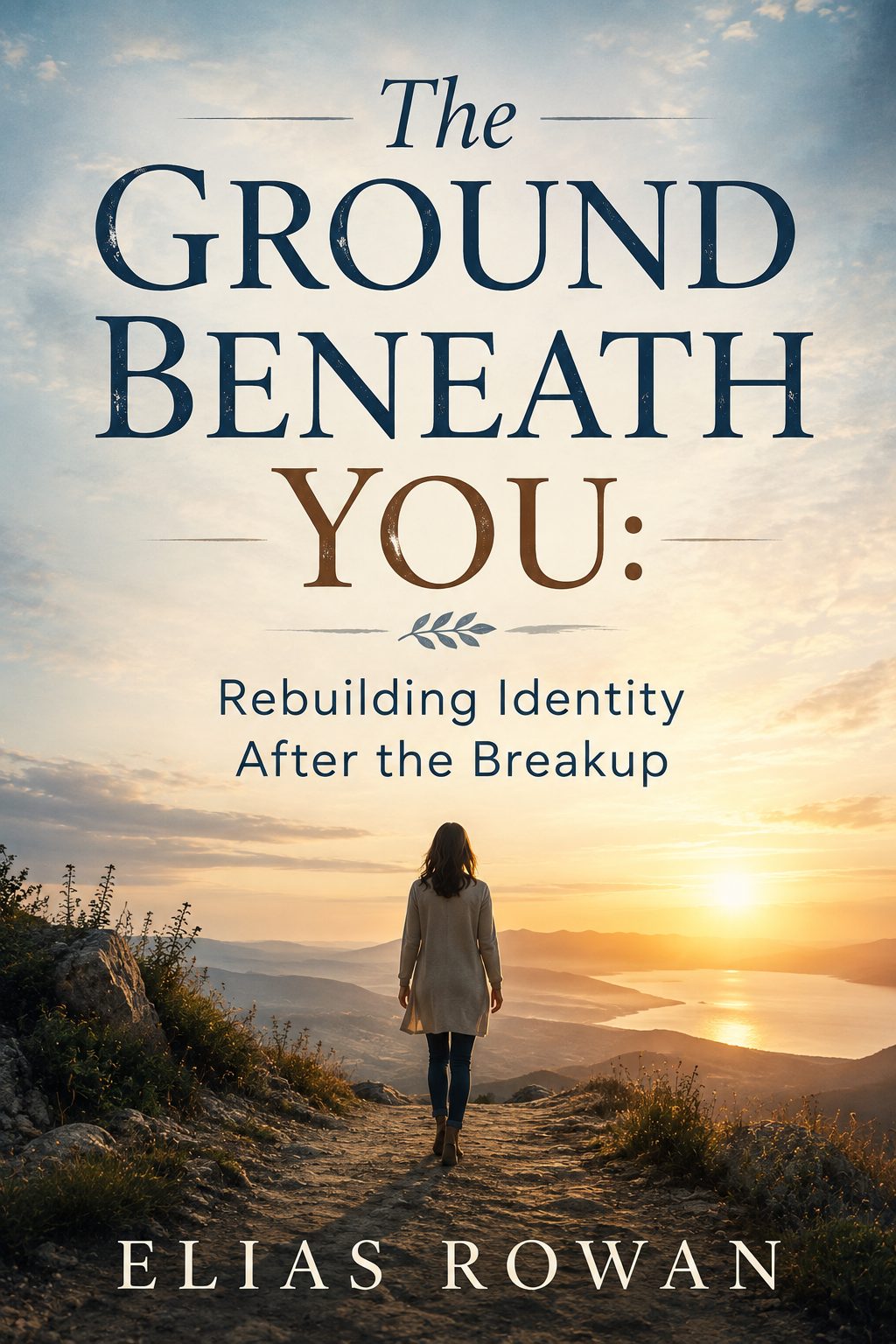
The Ground Beneath You: Rebuilding Identity After the Breakup
A narrative for the months after the shock fades
When the story you lived in ends, more than a partner goes. You do. For months you stayed busy, focused on work, gave it time — and still you don't recognize who's left. This is not another book of instruction. It's a narrative you live inside, not a manual you obey: you follow a therapist and her clients as they rebuild, and you do the work the way they do — living it, not reading steps.
- Not a book of instruction. You get your life back the way the characters do — living as someone working through it, feeling what she feels, walking the same path until it becomes your own
- The Identity Audit — a four-column grid that separates who you really are from the furniture and props a relationship required
- The four stages, shown honestly — destabilization, liminality, experimentation, integration — as a spiral you'll loop through, not a line to finish
- Why the timeline advice fails — the two clocks behind feeling better and still being attached, and why time alone doesn't do the work for you
- A full chapter on children in the crossfire — for the people the breakup was never only about
- The narrator's own story threaded through — a therapist building this framework out of her own unravelling, told without a single shortcut
E-book (PDF) · US Letter · 110 pages · narrative nonfiction
One quick step — where should we send your download and receipt?
Instant download after purchase. Print it, fill it in by hand, keep it where you'll see it.
What's inside
The Identity Audit
The heart of the book
The four-column grid the whole framework hangs on — works beside the companion workbook, but stands alone as the book's central tool.
The Four Stages, As a Spiral
The framework revealed
Destabilization, liminality, experimentation, integration — shown honestly as a loop, not a countdown, so you stop measuring yourself against a straight line that doesn't exist.
Why the Timeline Advice Fails
The honest clock
The two clocks (acute distress vs. the attachment bond) and the research-transparent reason 'time' alone doesn't do the work for you.
Children in the Crossfire
For the ones it was never only about
A full, dedicated chapter on the people a breakup was never only about — handled with the care the subject demands.
The Author's Own Story
Woven through every chapter
A therapist building the framework out of her own collapse, in real time — no shortcuts, no heroics.
Who it's for
You're past the first weeks — six months, a year, more — and the shock has faded into a stranger feeling you can't name. People tell you you're 'doing fine' while you feel like you're floating, watching your own life from a distance. You've read the checklist books and you're tired of being told you'll feel differently just by acting differently. This book was built for the identity work that happens after survival — for rediscovering who you are when the person who co-authored your 'us' is gone.
What makes it different
- You live it, you don't follow it. There are no numbered steps to check off; the teaching happens inside a story you walk through, the way the characters do.
- No fake timelines. Not another 'feel yourself again in 30 days' promise — the honest two-clock reality instead.
- No villain required. Repairs to your identity don't depend on demonizing your ex, and this book never asks you to.
- It's not a checklist, and it doesn't pretend to be one. If you want a pen-and-paper system, The Breakup Reset Workbook is the companion; this is the narrative that holds it together.
- Stands alone. No course, no app, no login — just a book you can live inside and come back to.
Questions, answered honestly
Is this a workbook or a book to read?
A book to read. It's narrative nonfiction — you follow a therapist and her clients as they rebuild. If you'd like a pen-and-paper system to work alongside it, that's The Breakup Reset Workbook, which pairs cleanly with this book's Identity Audit.
When should I read it?
It's built for the months after the shock fades — the stretch where you're functional but still don't recognize who's left. It works whether you're six months or two years out; the identity work it teaches isn't tied to a countdown.
Is this therapy?
No. It's a book of reflective narrative — a story that models a process. It doesn't replace professional help. If you're struggling with thoughts of self-harm, reach out to a crisis line now (988 in the US) or your local emergency services.
What format does it come in?
An e-book PDF, US Letter, 110 pages, downloaded instantly after purchase. No app, account, or course access required.
Who is this for?
People well past the first week who've done the 'stay busy' thing and still feel like a stranger in their own life — who want the identity work the checklist guides skips, delivered as a story they can live inside.