
There's a moment in every breakup that has its own physics. It's usually late, and it's usually the phone. You've typed something — maybe nine words, maybe four paragraphs — and your thumb is hovering over send. The message is not a decision. It's a pressure valve. And then you remember something you saw on social media: the 72-hour rule. Don't text for 72 hours. Don't react. Don't decide. Just wait.
Here's the honest version of that memory: the wait is a genuinely good idea. The number is made up.
The 72-hour rule isn't a study or a law. It's a piece of practical folklore with several unrelated lives — and buried inside it is a real psychological mechanism that the research actually supports. This article separates the two: where the rule came from, why a pause genuinely helps, and why the countdown can quietly work against you if you treat 72 hours as a magic number instead of a tool.
Key takeaways
- The 72-hour rule circulates in multiple unrelated forms — a breakup cooling-off protocol, the dating "3-day rule," a sales follow-up folklore, even a "72-hour intimacy rule." It has no single authoritative origin and no peer-reviewed basis as a breakup rule [1][2].
- The sales version's claim that response rates "drop 57%" after 72 hours is a marketing statistic we could not verify in independent research — treat it as unproven [2].
- The mechanism underneath the rule is real: the hot-cold empathy gap. In intense emotional states, people systematically mispredict how they'll feel and act once the state subsides, which is why decisions made in the first days of a breakup are unreliable forecasts of what you'll want later [3][4].
- The forecasting problem runs both ways: people overestimate how bad the first weeks will be, and the error is concentrated right at the start — so both "I must text them now" and "I'll never want to text them" are poor predictions from inside the first 72 hours [5].
- There is no evidence the urge to contact your ex expires at hour 72. Urges are part of the acute-distress clock that declines over weeks and months, and actively trying to suppress thoughts of them can make the thoughts more persistent [6][7].
- The honest version: use a pause, not a countdown. The rule's value is that it buys you a calmer state before you act — the number itself is arbitrary [3][8].
In this guide
1. What the 72-hour rule actually says
Ask five people what the 72-hour rule is and you'll get five answers, because the phrase does several jobs.
The breakup version. Don't text your ex, don't react to anything they do, and don't make any big decisions for 72 hours after the breakup. The goal is to stop the worst of the impulse — the begging text, the "last chance" ultimatum, the three-paragraph essay — before it ships. Popular breakup-therapy and coaching content frames it as emotional triage: contain, stabilize, then decide [1].
The dating version. The "3-day rule": wait three days after getting someone's number before texting them, so you don't look too eager. This one predates social media by decades — it's 1990s "playing hard to get" advice that got a second life on TikTok [2].
The sales version. Follow up with a lead within 72 hours or they go cold. This is the oldest recorded life of the rule, and the version whose "research" is the least verifiable [2].
The intimacy version. Connect — physically or emotionally — at least once every 72 hours to keep a relationship alive [1].
| Life of the rule | What it says | What it's for |
|---|---|---|
| Breakup cooling-off | Don't text, react, or decide for 72 hours | Stopping the impulsive message [1] |
| Dating "3-day rule" | Wait three days to text after getting a number | Signaling — not looking too eager [2] |
| Sales follow-up | Follow up within 72 hours or the lead goes cold | Closing while the lead is warm [2] |
| "72-hour intimacy" | Connect at least once every 72 hours | Keeping a relationship alive [1] |
Same number, four different jobs. That's the first clue that the number itself isn't the content. The content is the pause — three days is just a round way of saying "not now."
2. Where it comes from
Nobody owns the 72-hour rule, which is what makes its history hard to pin down. But the genealogy matters, because it tells you what kind of thing you're dealing with.
The sales version is the oldest. Some version of "strike while the lead is warm" has existed as long as sales has, and the specific "72 hours" framing now travels with a supporting statistic: that response rates drop by 57% when follow-up happens outside the window. That number circulates as if it were a study. It isn't — at least, not one we could find. It appears on sales-consulting marketing pages, and we could not locate an independent peer-reviewed source for it. Treat it as unproven [2].
The dating version — wait three days after getting a number — is a different animal: it's strategy advice about signaling. A 2026 fact-check by a speed-dating company that runs in-person events pulled their own behavioral data on it and called the rule "outdated, and increasingly counterproductive" — their matches who follow up when interested tend to do it within 24 to 48 hours, and manufactured distance reads as confusion rather than mystery to most daters under 35 [2]. That's event data, not a study, but it points the same direction as the research below: timing games are about anxiety, not attraction.
The breakup version is the newest, and it's coaching folklore: a portable rule that therapists, coaches, and apps repeat because it's simple and it works as a behavior container. "The 72-hour rule means giving yourself at least three days of no contact before reacting, texting, or reaching out" is the standard formulation [1]. There's no study that validates 72 hours specifically — the research supports the reason for a pause, not the number. Which brings us to the part that's actually interesting.
3. The real mechanism: hot states make bad forecasters
Why does a pause help at all? The best answer comes from a line of research called the hot-cold empathy gap, developed by the behavioral economist George Loewenstein [3].
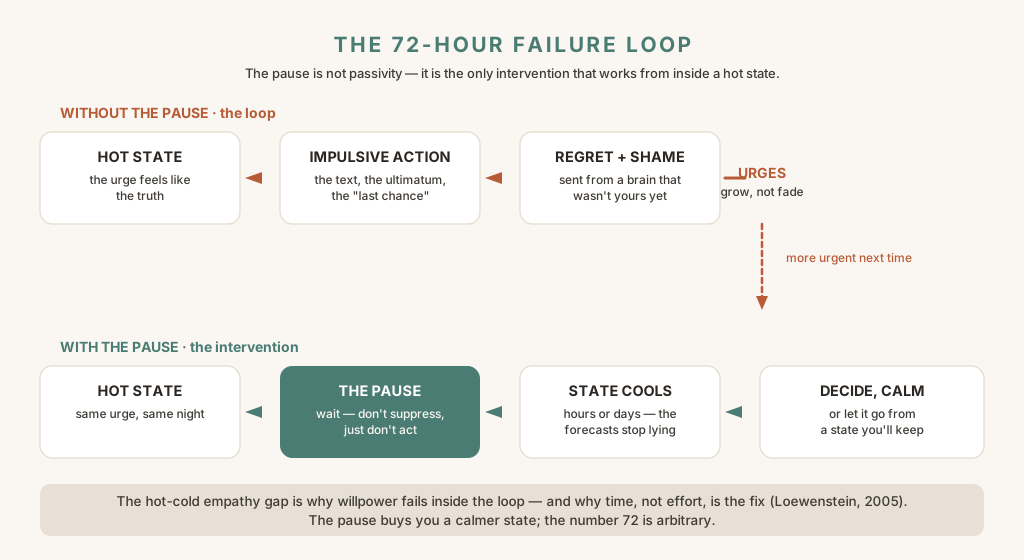
The core finding is almost unsettling: people in intense emotional states cannot accurately predict how they'll feel — or what they'll do — once the state passes. In a "hot" state (craving, rage, infatuation, acute grief), visceral forces override the parts of the brain that do deliberate decision-making. People under the influence of a hot state don't realize how much their choices are being driven by the state itself; they mistake what they want right now for what they'll want in general. The classic example is crimes of passion — people underestimate how much rage cools off once you delay the act. The same logic runs through phobias, cravings, and hunger [3].
Now apply it to the first 72 hours after a breakup. You are not in your normal state. You're in a hot state — the most intense one you may have been in for years. Every "decision" you make in that window — the text, the unfollow, the decision to move cities, the decision to never speak to them again — is being made by a brain that is temporarily not the one that will live with the consequences.
The gap also runs cold-to-hot: researchers tested smokers who were not currently craving and found they underpredicted how much they'd value a cigarette later, in a craving state [4]. The breakup mirror of this is the person who wakes up calm on day two, feels "fine," and concludes the breakup isn't a big deal — then gets blindsided by the wave on day four. Calm is as unreliable a forecast as panic, when it's sampled from the wrong state.
This is the real science underneath the 72-hour rule. The pause isn't magic. It's just the shortest reliable way to get out of the hot state before you act — and the research says you can't do that by willpower inside the state. You do it by waiting for the state to change.
4. The forecasting error runs both ways
There's a second body of research that explains why the first 72 hours feel so decisive — and why they're not.
In a 2008 study, people going through breakups were asked to predict how they'd feel over the coming weeks, and their predictions were compared with how they actually felt. The consistent finding: people overestimate how bad the first weeks will be. The error is concentrated right at the beginning — the forecasting gap is biggest exactly when you're in the worst of it — and for most people, the worst fades within roughly ten weeks [5].
Think about what that means for the 72-hour rule. In the window the rule is telling you to pause, your predictions are at their least reliable. "I will never get over this" is a forecast from a hot state — it's wrong, but it feels absolutely certain, which is exactly what the empathy-gap research predicts. And the reverse is also true: "I'm fine, I should text them now" on day two is equally unreliable, because the hot state can be temporarily absent before it returns.
The 72-hour rule accidentally encodes this. Its hidden wisdom is: your read on the situation, right now, is the least trustworthy read you will ever have of it. The pause exists because the instrument is broken — not because the situation will be fixed in three days.
| What was measured | What the research found |
|---|---|
| Predictions vs. actual distress in the first weeks | People overestimate how bad it will be; the error is biggest at the start [5] |
| How long the worst typically lasts | About 10 weeks for most people [5] |
| How long the urge to contact runs | The acute-distress clock — weeks to months, not hours [6][7] |
| How long the attachment bond runs | Years — a measured half-life of about four [7] |
Prefer to read it first? See what's inside the guide.
5. What the rule gets wrong
The pause is real. But the rule as commonly sold comes with three claims that don't survive contact with the research.
"By hour 72, the urge passes." There's no evidence of a magic expiry. The urge to contact your ex is part of the acute-distress clock that runs for weeks and months — it declines, but on the scale of months, not days [6][7]. What's more, actively trying to suppress thoughts of an ex has a documented backfire effect: the paradox of thought suppression is that effortful suppression can make the thought more persistent, not less [8]. "Just don't think about them for 72 hours" is asking you to do the one thing that makes the thought louder.
"If they don't miss you by day three, they never will." Nothing in the attachment or recovery research supports a three-day window for reconciliation. The attachment bond to an ex fades on a scale of years, not days [7]. Reconciliation, where it happens, follows patterns measured in weeks and months — not a 72-hour test [9].
"Silence is strategy." In the dating version of the rule, the pause is framed as a negotiation tactic: withhold and they'll want you more. The research on what actually predicts renewed interest points to consistent behavior over time, not manufactured scarcity [2][9]. Waiting can be self-protection; waiting as a performance for someone else is usually just waiting.
6. The honest version: use a pause, not a countdown
So what do you actually do with the 72-hour rule? Strip it of the number, and you have something worth keeping.
Treat the pause as a state-management tool, not a deadline. The goal isn't to "pass" 72 hours — it's to make your next action from a calmer state. That might take 24 hours. It might take three weeks. The research gives you the principle, not the timer [3].
Decide nothing important in the hot state. This is the rule that actually has evidence behind it. Big messages, big decisions, public announcements, ultimatums — none of them should be drafted, let alone sent, from inside the acute phase. The hot-cold research says your preferences in that state aren't your preferences [3][4].
If you must communicate — children, logistics, shared responsibilities — keep it short and factual. The pause rule was written for the impulsive text, not for co-parenting. Practical communication has a different job [1].
Don't fight the urge; time it. The thought-suppression research suggests the opposite of white-knuckling: let the urge be there, notice it, and don't act on it. The urge declines on the months-scale clock, not the hour-scale [6][7][8].
Use the time to check the actual recovery markers. The two clocks from our timeline research — acute distress (weeks to months) and the attachment bond (years) — are better gauges for where you are than any countdown [6][7]. The Breakup Timeline Calculator maps your weeks since the breakup onto those curves.
7. When the rule doesn't apply
The 72-hour rule assumes a normal breakup where no contact is safe and the risk is only your own impulsivity. That assumption has a boundary, and it's important to name it.
If the relationship involved abuse, the rule's logic flips. Contact — even "one last message" — can be a safety risk, and the professional guidance for leaving an abusive relationship is not a three-day pause but a safety plan, usually built with a professional or a domestic-violence organization. The urge to contact in that context is not an impulsive mistake to be delayed; it's a risk to be managed by people who know what they're doing. Nothing in this article overrides that.
The rule also isn't for emergencies. If you share children, property, or obligations that genuinely need communication, the pause was never about those.
And if the impulse you're managing isn't the urge to text but the urge to harm yourself or the feeling that you're unsafe — that's not a rule situation, that's a crisis situation. In the US, call or text 988 (Suicide & Crisis Lifeline), or contact your local emergency services. A countdown is for normal heartbreak. This is different.
FAQ
What is the 72-hour rule after a breakup?
The rule says don't text, react, or make big decisions for 72 hours after a breakup, to avoid impulsive actions you'll regret. It's a practical cooling-off protocol — useful as a behavior container, but the specific number has no research basis. The underlying mechanism (hot-cold empathy gap) supports the pause, not the 72 hours [1][3].
Does the 72-hour rule actually work?
The pause works; the number is folklore. Waiting until you're in a calmer state before contacting an ex or making decisions is supported by research on hot states and impulsive decisions [3]. There is no evidence that anything specific happens at hour 72, or that the urge to contact expires then [6][7].
Where did the 72-hour rule come from?
It has multiple unrelated origins: sales follow-up folklore ("respond within 72 hours"), 1990s-era dating advice about not looking eager (the "3-day rule"), and modern breakup-coaching content that repackaged the pause as a rule [1][2]. No single authoritative source exists.
Should I text my ex after 72 hours?
The rule gives no guidance here, because there's no evidence that day three is special. What the research supports: make contact decisions from a calmer state, keep practical communication short and factual, and don't treat silence as a negotiation tactic [3][5]. If you're testing whether they miss you, you're not actually waiting — you're negotiating.
Is the 72-hour rule the same as no contact?
No. No contact is a longer, structural decision about cutting off communication (weeks to months, sometimes indefinitely). The 72-hour rule is a short cooling-off window. The research on recovery supports meaningful space early on; it doesn't support any specific duration [6][7].
Why do I want to text them so badly right now?
Because you're in a hot state — the same mechanism that makes people send regrettable messages, make impulsive decisions, and mispredict their own futures [3]. The want is real, and it's also state-dependent: it won't feel like this forever, which is precisely why the pause exists [5].
Conclusion: the honest version
The 72-hour rule is a piece of folklore with a real heart. Somewhere inside the arbitrary number is a true insight: you are not a reliable decision-maker right now, and the only way to become one is to wait. That insight is worth more than the rule that carries it.
So keep the pause. Drop the countdown. Send nothing from the hot state, decide nothing from the hot state, and let the urge be present without obeying it — because the urge is one clock, and it runs on weeks and months, not hours [6][7]. When you act, act from the calmer state the pause was always for.
And when you do, you'll have a better map for where you are. The research on recovery — the two clocks, the phases people actually move through, the five stages myth, and the honest timeline — is the alternative to every round number the internet hands you. The honest 90-day plan walks through what the weeks actually look like.
The text can wait. That's the whole rule — and it was never really about 72 hours.
Sources
- Therapy and coaching pages carrying the breakup 72-hour rule (accessed 2026-08-24): Life Reclaimed Therapy — No Contact After Breakup; Let It Go — What is the 72-hour rule after a breakup?; Ahead App — Why Waiting 72 Hours Matters for Impulsive Breakups — secondary; represent the rule as circulated (cooling-off / emotional triage framing).
- MyCheekyDate (2026). We fact-checked 5 viral TikTok dating rules. Our data says otherwise. — Article (read directly 2026-08-24; speed-dating event data, not an academic study); sales "72-hour follow-up / 57%" claim: Sales Systems University — marketing page, statistic unverified in independent sources.
- Loewenstein, G. (2005). Hot-cold empathy gaps and medical decision making. Health Psychology, 24(4) Suppl., S49–S56. — Wikipedia: Hot-cold empathy gap + BehavioralEconomics.com summary read directly 2026-08-24 (secondary to the paper).
- Sayette, M. A., Loewenstein, G., Griffin, K. M., & Black, J. J. (2008). Exploring the cold-to-hot empathy gap in smokers. Psychological Science, 19(9), 926–932. — via BehavioralEconomics.com summary, accessed 2026-08-24 (secondary; paper not read directly).
- Eastwick, P. W., Finkel, E. J., Krishnamurti, T., & Loewenstein, G. (2008). Mispredicting distress following romantic breakup. Journal of Experimental Social Psychology, 44(3), 800–807. — Author manuscript (read directly during our timeline article production, 2026-08-24).
- O'Hara, K. L., et al. (2020). Clinical Psychological Science. — Separation distress declined linearly 30.42 → 24.15 → 20.69 across five months; contact with the ex predicted higher distress two months later. Full text, PubMed Central (read directly during our timeline article production, 2026-08-24).
- Chong, S. C., & Fraley, R. C. (2025). Social Psychological and Personality Science. — Attachment bond to an ex has a half-life of ~4 years (midpoint 4.18 years). Abstract + authors' summary read directly during our timeline article production, 2026-08-24.
- Wegner, D. M., Schneider, D. J., Carter, S. R., & White, T. L. (1987). Paradoxical effects of thought suppression. Journal of Personality and Social Psychology, 53(1), 5–13. — APA summary (verified during our timeline article production, 2026-08-24).
- Halpern-Meekin, S., et al. Relationship churning in emerging adulthood: On/off relationships and sex with an ex. — Full text, PubMed Central — reconciliation is common (~45% of young adults) and rarely a one-time event; no timing rule governs it (read directly 2026-08-24 for our 3-week-rule article).
- Monitoring an ex-partner on social media is associated with greater breakup distress, negative affect, and jealousy (2025). Computers in Human Behavior. — Publisher page (verified during our timeline article production, 2026-08-24).
Methodology
How this was compiled. This article was researched and written on 2026-08-24. The rule's circulating forms were documented by reading the therapy, coaching, sales, and dating pages that carry it (Source 1–2). The anchor scientific claims were verified against established research: the hot-cold empathy gap (Source 3 — Wikipedia and BehavioralEconomics.com summaries of Loewenstein 2005, read directly), the cold-to-hot gap (Source 4 — secondary summary), and the affective forecasting error (Source 5 — author manuscript read directly during production of our timeline article). Recovery-clock evidence (Sources 6–7, 10) was verified in full when we produced our timeline article and is reused here. The "57%" sales statistic (Source 2) could not be verified in independent research and is labeled as such.
What is not claimed. We are not claiming the 72-hour rule is useless — the pause it encodes is genuinely supported. We are claiming the specific number has no research basis, which is the finding. We are not claiming reconciliation follows any timing rule; the churning research (Source 9) shows cycling is common but unclocked. No first-hand clinical experience is claimed; the author is an editorial lead, not a therapist. This article's advice assumes a breakup where no contact is safe — it does not apply to abusive relationships, where contact management belongs in a safety plan with professionals. If you are in crisis, call or text 988 (US) or your local emergency services.
Update schedule. Reviewed monthly against the cited research and the circulating forms of the rule, consistent with the site's freshness policy for recovery content.