
There's an hour of the night when people ask this question. It's usually not noon — it's after midnight, when you've counted the days twice and the arithmetic is getting desperate. Three weeks, says one post. Three and a half months, says a poll. Half the relationship, says a friend. You're ten weeks out and you still reached for your phone before you remembered. None of the numbers feel true.
They're all wrong in the same way. They treat "getting over someone" as one event with one timer. The research says recovery runs on two clocks at once — an acute-distress clock that runs in weeks and months, and an attachment clock that runs in years. Both are real. Neither means you're broken.
Quick answer: how long does it take to recover from a breakup?
There's no honest single number, because recovery runs on two clocks. Acute distress — the heaviness, the crying, the fog — lifts measurably within weeks to months for most people (one study tracked it falling from ~30 to ~21 on a 100-point scale across five months). The attachment bond fades on a different scale: for people in relationships of two years or more, it has a half-life of about four years. So the honest answer is: most people feel a real, visible shift in the first few months, and some background attachment can linger for years — and both are normal. The pain isn't the bond.
Key takeaways
- The emotional attachment to an ex has a half-life of about 4 years for people from long-term relationships (Chong & Fraley, 2025) [1].
- Acute distress is a different clock: it declined steadily from 30.4 to 20.7 (0–100 scale) across Months 1–5 in one study (O'Hara et al., 2020) [4].
- Language patterns changed by a breakup return to normal within about 6 months — after starting ~3 months before (Seraj, Blackburn & Pennebaker, 2021) [3].
- People overestimate how bad the first weeks will be; the worst faded within about 10 weeks in a forecasting study (Eastwick et al., 2008) [6].
- Contact keeps the attachment alive: in-person contact predicted higher distress 2 months later, and one standard deviation of extra contact offset 112% of the normal two-month decline (O'Hara et al., 2020) [4].
- The famous numbers — the 3-week rule, "3.5 months," "half the relationship" — are folklore and polls, not studies [11][12][13].
Quick answers
Why am I not over my ex after two months?
Feeling worse at month two than at week two is the data's expectation, not failure. The shock fades fast, but the absence becomes daily life — language patterns don't normalize for about six months (Eastwick et al., 2008 [6]; Seraj et al., 2021 [3]).
Am I over them, or just still attached?
They're two different clocks. "Over them" is the acute distress — the heaviness and crying — declining over weeks to months; "still attached" is the background bond, fading on a scale of years (O'Hara et al., 2020 [4]; Chong & Fraley, 2025 [1]). The bond isn't the pain.
In this guide
- The question no number can answer
- Two clocks, not one
- Clock 1: acute distress lifts in weeks to months — 30.4 → 20.7 in five months
- Clock 2: the attachment bond runs on years — a ~4-year half-life
- The famous numbers are folklore
- What makes the clocks run slower
- Why the first weeks feel unbearable — and why that's predictable
- The hardest stage isn't the first week
- Signs you're actually healing — and when to get help
- What to do with the time
1. The question no number can answer
Every night, the same question gets typed into the same search bar by people who'd never ask it out loud: how long does it take to get over a breakup? It's asked in r/BreakUps — roughly 572,000 members — in the same words, week after week. The question isn't new. The answers just pretend to be.
The famous answers share an origin: none came from a study about how long recovery takes. "3.5 months" is a market-research poll run for Yelp [11]. The "11 weeks" figure circulates from press coverage of a 2007 study whose primary text is paywalled — we couldn't verify the number against the paper itself [12]. The "3-week rule" exists on social media and nowhere in the scientific literature we could find. And "half the relationship length" is folk math the research now contradicts [13].
That's the pattern to notice: when a number is easy and round, ask where it came from. The research doesn't produce one tidy number — it produces a shape, and the shape is more useful than any single figure.
2. Two clocks, not one
Here's the reframe that changes everything: "getting over someone" isn't one process with one finish line. The research consistently measures two different things on two different timescales.
Clock 1 is acute distress — the heaviness, the crying, the lost appetite, the fog. It runs in weeks and months, and it declines measurably over the first months for most people [4][5][6].
Clock 2 is the attachment bond — the background pull toward someone who used to be your person. It runs in years. A 2025 study measured its half-life directly: for people who'd been in relationships of two years or more, the emotional attachment to an ex was halfway gone about four years after the relationship ended [1][2].
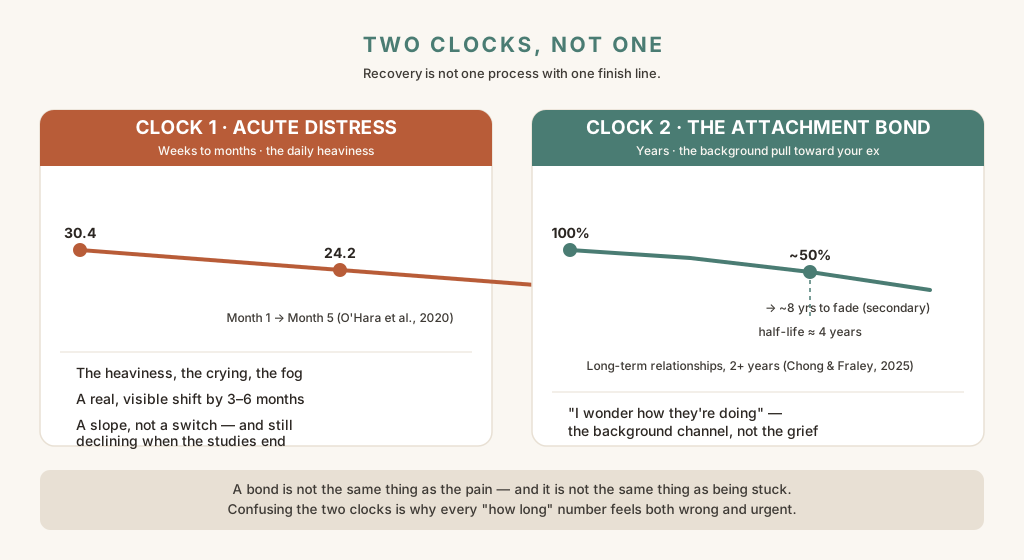
Most of the pain of the "how long" question comes from conflating the two. You're ten weeks out, the heaviness is genuinely lighter, and you're still furious at yourself because you thought of them at 2 p.m. That's not a failed clock 1. That's clock 2 running exactly as it does — on a scale of years. You're not late. You're on a different timer than the one the advice assumed.
3. Clock 1: acute distress lifts in weeks to months — 30.4 → 20.7 in five months
Start with the study that tracked the sharpest numbers. O'Hara and colleagues followed 122 recently separated adults — married an average of 13.4 years — assessing them three times over five months, starting about four months after separation. Their combined distress score (0–100: depression, intrusive thoughts, loss of self, grief) fell in a straight line:
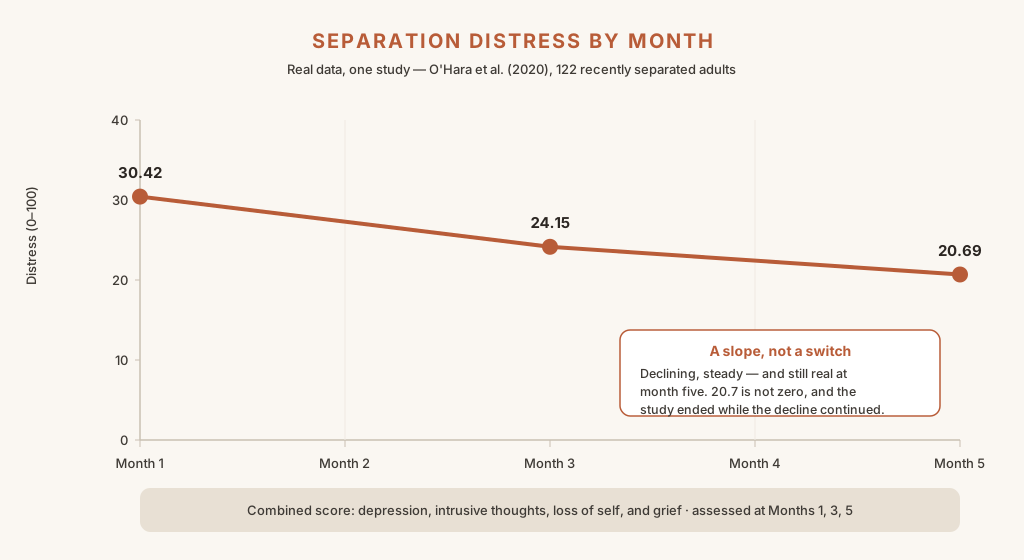
| Month since separation | Distress (0–100) |
|---|---|
| Month 1 | 30.42 |
| Month 3 | 24.15 |
| Month 5 | 20.69 |
Source: O'Hara et al. (2020) [4].
Notice what that chart doesn't say. It doesn't say anyone was "over it" by Month 5 — 20.7 is not zero. It says the pain is a slope, not a switch: it declines, it declines steadily, and it's still declining when the study ends. If you're expecting one morning you wake up fine, you're expecting a shape the research doesn't show.
Other studies line up. Seraj, Blackburn and Pennebaker analyzed about a million Reddit posts from roughly 6,800 people who went through breakups and found the language changes lasted about six months after the breakup — having begun about three months before [3]. A 28-day diary study of 58 young adults found love declining linearly and sadness and anger falling in a curve over the first month [5]. And an affective-forecasting study found something quietly reassuring: people systematically overestimate how bad the early weeks will be — the error is concentrated on the initial blow, while actual distress fades steadily, with the worst gone within about ten weeks [6].
Honest version of clock 1: measurable improvement in weeks, a real and visible shift by the 3–6 month mark for most people, and a slope rather than a finish line.
4. Clock 2: the attachment bond runs on years — a ~4-year half-life
Now the number that's harder to hear, because it's honest.
Chong and Fraley studied about 320 adults who'd been in relationships of at least two years and were no longer in them. Using models borrowed from radioactive decay, they estimated the half-life of the emotional attachment to an ex at roughly four years — the point where the bond has faded halfway [1][2]. For the average person the bond eventually becomes what the authors call "someone they used to know" — but "eventually" is doing a lot of work.
| Attachment finding | What the research shows |
|---|---|
| Half-life of the emotional bond | ~4 years (midpoint 4.18) after the relationship ends [1] |
| Time until the bond is fully gone | ~8 years on average (secondary estimate) [14] |
| Bonds in people still in contact | Never fully faded for some [2] |
| Bonds in people who didn't initiate | Often persisted 10+ years [2] |
| Starting a new relationship | Did not speed the fading [2] |
| Contact with the ex | The strongest predictor of a persistent bond [14] |
Source: Chong & Fraley (2025) [1][2]; Psychology Today secondary coverage [14].
Two cautions before this lands wrong. First, this is a bond, not a pain. A bond is "I wonder how they're doing" — the background channel, not the grief. You can have a bond still fading at year two and be completely functional, dating, and happy. Second, the sample was people from long-term relationships of two-plus years, many together for nearly five [13]. If your relationship was six months, these numbers don't apply to you. The point isn't "you'll be stuck for four years." The point is that some lingering attachment is measurable, normal, and slow — and it isn't the same thing as not healing.
Prefer to read it first? See what's inside the guide.
5. The famous numbers are folklore
Let's do what almost no "how long" article does: show each famous number and where it actually comes from.
| The claim | Where it actually comes from |
|---|---|
| "The 3-week rule: over it in 21 days" | Social-media folklore. We could not find a peer-reviewed source for it. |
| "3.5 months, on average" | A market-research poll conducted for Yelp — not a study [11]. |
| "11 weeks and 71% feel better" | Press coverage of a 2007 Journal of Positive Psychology study; the paper is paywalled and we couldn't verify the figure [12]. |
| "Half the length of the relationship" | Folk math from a Sex and the City line. The BPS Research Digest tested it against attachment data and called it unlikely [13]. |
| "72 hours and the urge passes" | No evidence of a magic expiry. Urges are the central struggle of early recovery [15]. |
None of these deserve the confidence they're repeated with. The research doesn't support any round number — it supports the two-clock shape, and a short list of things that change how fast the clocks run.
6. What makes the clocks run slower
The best-verified finding here is also the most uncomfortable: contact keeps the clock running. In the O'Hara study, more in-person contact with an ex predicted higher distress two months later — for adults without shared children. The effect wasn't small: one standard deviation of extra contact offset about 112% of the normal two-month decline [4]. The attachment study found the same mechanism at the far end of the timescale: people who stayed in contact with an ex were the ones whose bonds never fully faded [2].
A gentler version of the same finding: passive monitoring. A 2025 study found that actively watching an ex on social media predicted greater distress, negative affect, and jealousy up to six months out [10]. You don't have to text them to keep them present — checking their profile does some of the same work.
| What slows recovery | What the research shows |
|---|---|
| In-person contact (no shared children) | Higher distress 2 months later; ~112% of normal decline offset [4] |
| Staying in contact, long-term | Bond can persist a decade or more; never fully fades for some [2] |
| Social-media monitoring | Greater distress up to 6 months out [10] |
| Not being the one who ended it | Bonds often last 10+ years for non-initiators [2] |
| Identity entanglement | The bigger the shake to "who am I without them," the more distress [8] |
| Loss-side rumination without restoration | Predicts prolonged distress (dual-process model) [16] |
Two more factors aren't about contact. The first is identity: a six-month longitudinal study of freshmen found that people who broke up had a measurable drop in how clearly they knew themselves — and that drop, not just the rejection, predicted distress [8]. In naturalistic writing, people who'd recently broken up described themselves with far fewer words than people who hadn't (4.64 vs 9.18 descriptors in one analysis) — they didn't know who they were without the other person [8]. The second is initiation: people who didn't initiate the breakup held bonds that often lasted over a decade, while initiators faded faster [2].
The good news hiding in all this: if contact, monitoring, and identity entanglement are the slowers, then boundaries, attention, and rebuilding are real levers — not platitudes.
7. Why the first weeks feel unbearable — and why that's predictable
Before the levers, one more piece of honesty: the first weeks are supposed to feel like this.
Brain-imaging research found that looking at a photo of a rejecting ex activates the same regions involved in motivation, reward, and craving — the ventral tegmental area, the nucleus accumbens — alongside regions associated with physical pain [7]. In that study, participants had been rejected an average of 63 days earlier and were still spending more than 85% of their waking hours thinking of the person [7]. The urge to text, to check, to "accidentally" run into them isn't a character flaw; it's a craving circuit doing its job.
Two practical consequences follow. First, willpower is the wrong tool — suppression backfires; the harder you try not to think of something, the more you think of it [15]. Second, the urge has a shape: it peaks, and it passes. You don't need to win the whole war at 11 p.m.; you need to not act for the hour the peak lasts. That's a much smaller job — and it's what our 90-day breakup plan is built around, with a 10-minute urge plan for the moment the pull hits.
8. The hardest stage isn't the first week
If you're bracing for the worst day and it hasn't come, you may be waiting for the wrong day.
The data points the same direction: the forecast of the acute blow is worse than the reality [6], and the measured slope shows the first month as the highest point of a decline already underway [4]. What stretches further is the period after the shock wears off — the weeks and months when the absence stops being novel and becomes routine. The language changes don't normalize until about six months out [3], and identity clarity stays low in the weeks after a breakup even as the raw pain fades [8].
In plain terms: for many people the hardest stage isn't the first week — it's the second and third months, when everyone around you has moved on and the absence has settled in as daily life. This matches what our guide to the 5 stages of a breakup describes: the honest map is oscillation, not a linear march. If you felt worse at month two than at week two, you weren't doing it wrong — you were in the phase the data says is the long one.
This shape holds for men too. The idea that men simply shake a breakup off in a week is contradicted by the recovery data, which finds no meaningful gender difference in how hard a breakup hits or how long it takes — what differs is that a man is more often left, and more likely to carry the grief privately. That's the subject of our piece on how men actually recover from breakups. Either gender can hit the "worse at month two" phase; neither is doing it wrong.
9. Signs you're actually healing — and when to get help
Because the clocks run on different timescales, the signs of healing aren't what the advice columns say. You can be healing and still think of them daily.
What healing looks like in the research: the frequency and charge of the thinking changes. The language study's slow-recovery group showed prolonged preoccupation, heavy reference to the ex, and difficulty untangling identity from the relationship — the people who healed showed those signals fading [3]. Distress trending down across months — the O'Hara slope — is the same shape on a survey scale [4]. And the day-to-day lever with the strongest evidence isn't a feeling; it's behavior. Behavioral activation — doing rewarding, scheduled activities even when you don't want to — is among the most evidence-based treatments for depression [17], and a fully automated digital version measurably reduced breakup-related rumination and complicated grief symptoms [18]. You don't heal by feeling ready to act. You heal by acting, which eventually changes the feeling.
When to worry: the Seraj team's own guidance is refreshingly direct — if you're in deep emotional distress six months or a year after the breakup, it's a good time to seek professional help [3]. Lingering attachment alone isn't that signal; the half-life data says it's normal. The signal is distress that isn't declining, functioning still collapsing at the year mark, or thoughts of self-harm — which are always a reason to reach out now. If you're past the early months and the stuck feeling is the whole story, our guide on what to do when you feel you can't recover from a breakup goes deep into the research behind that fear — and when persistent distress has a name and a treatment.
If you're in crisis, call or text 988 (US) or your local emergency number, or reach a professional you trust.
10. What to do with the time
The honest summary, in one paragraph: acute distress lifts in weeks to months for most people — a slope, not a switch, with the worst of the forecasting error concentrated in the first weeks [4][6]. The attachment bond fades on a scale of years, with a half-life around four for long-term relationships [1]. You can't speed the second clock with willpower, but you can stop feeding it: contact and monitoring are the strongest, most consistent predictors of a slower fade [2][4][10], and rebuilding — identity, routines, activities — is the mechanism the research keeps circling back to [8][17][18]. The identity piece is often the one that feels least actionable, but the research on "who am I without them" shows it's the part that recovers first — ahead of overall well-being — which makes it the highest-leverage place to start.
None of that gives you a countdown. It gives you a map. The first seven days are the hardest to survive in one piece — our free First 7 Days guide walks that week hour by hour, from the same research. For the longer arc, the 90-day plan turns the two clocks into three phases of things you can actually do.
If you want a number instead of a model, use the how-long-to-get-over-a-breakup calculator. Plug in how long you were together and how long it's been, and it plots you on the research curves instead of the folklore — two clocks, not one countdown. Keep the two clocks in mind even after you've used it: if the heaviness has lightened in weeks and months, clock 1 is working. If you still think of them on a bad day at month eight, that's clock 2 — normal, slow, and not the same thing as being stuck.
FAQ
Is there a calculator for how long it takes to get over a breakup?
Yes — our Breakup Timeline Calculator takes how long you were together and how long it's been and places you on the two research curves (acute distress, which lifts in weeks to months, and the attachment bond, which decays over roughly four years). It won't give you a finish date, because no honest tool can: the research supports ranges and trajectories, not deadlines. What it does give you is a way to tell whether the heaviness lightening over months is clock 1 working as expected — instead of measuring yourself against folklore numbers.
How long does it take to get over a breakup?
There is no honest single number, because two clocks run at once. Acute distress declines measurably within weeks to months for most people (O'Hara et al., 2020) [4], and the language changes from a breakup normalize within about six months (Seraj et al., 2021) [3]. The attachment bond fades on a different scale: a 2025 study put its half-life at about four years for people from long-term relationships (Chong & Fraley, 2025) [1]. Feeling heavy at six months and still thinking of them at two years are both normal — and they're not the same clock.
Am I recovering after a breakup if I still think of them?
Yes. Recovery and lingering attachment are different clocks. Thinking of them months out is the attachment bond fading on a scale of years, not the acute distress failing to lift (O'Hara et al., 2020 [4]; Chong & Fraley, 2025 [1]). You're recovering if the heaviness is lightening, the thinking is losing its charge, and your days are yours again — even if the person still crosses your mind. The bond isn't the pain.
What is the 3 week rule of breakups?
A piece of folklore with no evidence behind it. Searches for "the three-week rule" surface only social-media posts — no peer-reviewed source we could find. Healing isn't a countdown with a magic number at the end; the research on the attachment bond suggests the deeper process runs on a scale of years, not weeks [1].
What is the hardest stage of a breakup?
For most people, not the first week — the weeks and months after, when the shock fades and the absence becomes daily life. People overestimate the initial blow while actual distress fades within about ten weeks (Eastwick et al., 2008) [6]; the language changes take about six months to normalize (Seraj et al., 2021) [3]. Feeling worse at month two than at week two is the data's expectation, not a failure.
Does it take half the length of the relationship to get over someone?
No — that "half the relationship" rule is folk math with no clinical basis. The 2025 attachment study found bonds fade on a scale of years regardless of a tidy ratio [1], and the BPS Research Digest called the rule unlikely to be true [13]. Recovery depends more on contact, monitoring, rumination, and rebuilding than on a calendar formula.
Why can't I stop thinking about them?
Because romantic rejection activates the same brain regions involved in motivation, reward, and addiction — and the attachment bond behind it has a half-life of years. In an fMRI study, recently rejected people spent more than 85% of waking hours thinking of their ex, on average 63 days after the rejection (Fisher et al., 2010) [7]. A part of you staying oriented toward them is a measurable, normal process — not a personal failure. If the thoughts themselves are running your days, our guide on how to stop thinking about your ex covers the evidence-based levers.
When should I worry that I'm taking too long to get over it?
The researchers behind the six-month language study put it simply: if you're still in deep emotional distress six months or a year after the breakup, it's a good time to seek professional help [3]. A rough marker from the same study: prolonged preoccupation, heavy reference to your ex, and difficulty untangling your identity from the relationship. Lingering attachment alone isn't the same as being stuck — the two are different clocks. If you're in crisis, call or text 988 (US) or your local emergency number now.
Does staying in contact with my ex slow recovery?
Research says it can, in two ways. In a study of 122 separated adults, more in-person contact predicted higher distress two months later — but only for people without shared children; contact offset about 112% of the normal two-month decline for that group (O'Hara et al., 2020) [4]. And the attachment study found that for people who stay in contact, the bond can remain strong for a decade or more — in some cases never fully fading (Chong & Fraley, 2025) [2]. With shared children, routine contact is a different situation, and the research doesn't show the same effect.
Why am I not over my ex after two months?
The measured hardest stretch isn't the first week — it's months two and three, when shock fades into daily absence. People overestimate the first weeks' pain; language patterns don't normalize for about six months (Eastwick et al., 2008 [6]; Seraj et al., 2021 [3]).
Am I over them, or just still attached?
They're two different clocks. "Over them" is the acute distress — the heaviness and crying — declining over weeks to months; "still attached" is the background bond, fading on a scale of years (O'Hara et al., 2020 [4]; Chong & Fraley, 2025 [1]). The bond isn't the pain.
The honest version of the timeline
Here's what the "how long" question is really asking at 2 a.m.: will this end, and when will I know?
The answer the research supports is quieter than any number. Yes, it ends — the distress declines and the bond fades, on two different clocks, and neither is a verdict on you. You'll know you're healing not by a date on a calendar but by the shape of your weeks: the heaviness lifting, the thinking losing its charge, the person becoming someone you used to know.
You're not late. You're on the clock you're on. The number that matters isn't the one anyone quoted you — it's what you do with the hours while both clocks run.
Sources
- Chong, J. Y., & Fraley, R. C. (2025). The Long-Term Stability of Affective Bonds After Romantic Separation: Do Attachments Simply Fade Away? Social Psychological and Personality Science, 17(1), 120–133. — Read directly: journal abstract, Sage
- Fraley, R. C., & Chong, J. (2025). Do We Ever Truly "Get Over" an Ex? SPSP Character & Context Blog. — Read directly: authors' own summary of their study
- Seraj, S., Blackburn, K. G., & Pennebaker, J. W. (2021). Language left behind on social media exposes the emotional and cognitive costs of a romantic breakup. Proceedings of the National Academy of Sciences, 118(7), e2017154118. — Read via the study authors' own summary: SPSP; DOI
- O'Hara, K. L., Grinberg, A. M., Tackman, A. M., Mehl, M. R., & Sbarra, D. A. (2020). Contact with an ex-partner is associated with psychological distress after marital separation. Clinical Psychological Science, 8(3), 450–465. — Read directly: full text, PubMed Central
- Sbarra, D. A., & Emery, R. E. (2005). The emotional sequelae of nonmarital relationship dissolution: Analysis of change and intraindividual variability over time. Personal Relationships, 12(2), 213–232. — Read directly: abstract, University of Arizona experts page
- Eastwick, P. W., Finkel, E. J., Krishnamurti, T., & Loewenstein, G. (2008). Mispredicting distress following romantic breakup: Revealing the time course of the affective forecasting error. Journal of Experimental Social Psychology, 44(3), 800–807. — Read directly: author manuscript
- Fisher, H. E., Brown, L. L., Aron, A., Strong, G., & Mashek, D. (2010). Reward, addiction, and emotion regulation systems associated with rejection in love. Journal of Neurophysiology, 104(1). — Read directly: study summary, Rutgers
- Slotter, E. B., Gardner, W. L., & Finkel, E. J. (2010). Who am I without you? The influence of romantic breakup on the self-concept. Personality and Social Psychology Bulletin, 36(2), 147–160. — Read directly: full text, author manuscript
- Sbarra, D. A. (2006). Predicting the onset of emotional recovery following nonmarital relationship dissolution: Survival analyses of sadness and anger. Personality and Social Psychology Bulletin, 32(3), 298–312. — Publisher page
- Monitoring an ex-partner on social media is associated with greater breakup distress, negative affect, and jealousy (2025). Computers in Human Behavior. — Publisher page
- Raypole, C. (2024). How long does it take to get over a breakup? It depends. Healthline. — Article (identifies the "3.5 months" figure as a Yelp market-research poll)
- Vice (2020). The new breakup equation: how long it will take to get over an ex. — Article (press report of the 2007 JPP finding; primary text not accessible)
- Reynolds, E. (2025). How long does it take to get over an ex? BPS Research Digest. — Article (coverage of Chong & Fraley 2025; challenges the half-relationship rule)
- Brogaard, B. (2025). How long it really takes to get over an ex. Psychology Today. — Article (secondary; ~8 years to full dissolution on average)
- Wegner, D. M., Schneider, D. J., Carter, S. R., & White, T. L. (1987). Paradoxical effects of thought suppression. Journal of Personality and Social Psychology, 53(1), 5–13. — Read directly: APA summary
- Shulman, S., & Yonatan-Leus, R. (2024). Understanding young people's relationship breakups using the dual-processing model of coping and bereavement. Journal of Social and Personal Relationships. — Publisher page
- Ekers, D., et al. (2011). A pragmatic randomised clinical trial of behavioural activation for depressed adults. British Journal of Psychiatry. — Read directly: full text, PubMed Central
- Examining a fully automated mobile-based behavioral activation intervention for complicated grief and rumination (2024). JMIR Mental Health. — Read directly: full text
Methodology
This data article was researched on 2026-08-24. Thirty-six sources were consulted and eighteen are cited. Key claims were verified by reading primary sources directly: the attachment half-life (Sources 1–2: journal abstract on Sage plus the study authors' own summary on SPSP), the five-month distress decline and contact effect (Source 4, full text on PubMed Central), the forecasting error (Source 6, author manuscript), the identity findings (Source 8, full text), the language-signature timing (Source 3, the study authors' own summary), the brain-imaging findings (Source 7, Rutgers' summary of the study), and the behavioral-activation evidence (Sources 17–18, full texts). Secondary sources are labeled as such in the text and fact sheet (Sources 10–14): the Computers in Human Behavior finding was verified only at the publisher page; the "11 weeks / 71%" figure could not be verified against the 2007 primary text, so it is reported as press coverage, not as a fact. The "3-week rule" was checked against the literature and no peer-reviewed source was found.
What is not claimed: this is not therapy or medical advice. No recovery timeline is guaranteed; the four-year half-life is a group average from adults in relationships of two-plus years — it does not apply to short relationships, and it describes the attachment bond, not the pain. The six-month language figure comes from the study authors' own summary of their PNAS paper. Group averages hide wide individual variation. Both programmatic visuals (the two-clocks diagram and the distress chart) contain only real numbers from the cited studies or structural illustration — no invented statistics. Update schedule: cited data points will be re-checked quarterly, or when the underlying evidence changes; the article shows a "Last updated" date at publication.