
There's a particular kind of quiet that follows the end of a serious relationship. Not the quiet of a peaceful house — the quiet of a life that suddenly has no next thing in it. No plans to make, no one to tell about something funny, no reason to check your phone. You reach for it anyway, every few minutes, out of muscle memory. Then you remember.
The honest answer, in one line: you get over a breakup by rebuilding a life that was built around another person — and the rebuilding is something you can do on purpose, in phases, without hating your ex and without waiting for a switch to flip.
If you're in that place right now, you've probably heard the standard advice: block them, work on yourself, give it time. It's not wrong — it's just incomplete, and incompleteness is cruel when you're this lost. "Give it time" doesn't tell you what to do with the hours; "work on yourself" doesn't tell you how. This guide is a structure: three phases, ninety days as a container rather than a promise, and practices you can actually do on the worst day.
Quick answer: how do you recover from a breakup?
Recovering from a breakup is a process of rebuilding a life that was built around another person — and you do it on purpose, in phases, without needing to hate your ex and without waiting for a switch to flip. In plain terms: first you stabilize (keep your days running while the shock settles), then you detach (break the attachment loop without demonizing them), then you rebuild (restore the identity and routines the relationship held). There's no honest single deadline — recovery is a slope, not a switch — but ninety days is a realistic container for a real shift, and the three phases below give you something concrete to do in each one.
Key takeaways
- Recovery is a slope, not a switch — and lingering attachment slows it (Sbarra, 2006) [2].
- The first weeks feel like withdrawal because rejection activates the same brain regions as reward and craving (Fisher et al., 2010) [1].
- You don't have to stop loving them to rebuild — breakups shake your sense of who you are, and rebuilding restores it (Slotter, Gardner & Finkel, 2010) [6].
- Suppression backfires: the harder you try not to think of them, the more you do (Wegner et al., 1987) [5].
In this guide
- Quick answer: how do you recover from a breakup?
- Why generic breakup advice fails
- First, the honest timeline
- The 5 stages of a breakup — and the more honest map
- I still love them — what that actually means
- The 72-hour rule — what's real and what isn't
- Phase 1 — Stabilize (Days 1–30)
- Phase 2 — Detach without demonizing (Days 31–60)
- Phase 3 — Rebuild (Days 61–90)
- How to accept that the relationship is over
- When to get professional help
1. Why generic breakup advice fails
The advice loop goes like this: Block them. Work on yourself. Time heals. Move on. Each piece contains a grain of truth, but put together they fail the same way: they treat healing as something that happens to you if you do nothing wrong.
Block them, and the urge to unblock gets worse — you've made your ex into a forbidden thought, and forbidden thoughts become the loudest ones in the room. "Work on yourself" is a command without instructions. Time heals, but not passively — the same week that helps one person move forward leaves another replaying one conversation for the thousandth time. And "move on" is the most dishonest advice of all: you can't move on from a life you haven't rebuilt yet.
There's a reason people keep asking the same questions. In the largest breakup communities online — r/BreakUps alone has hundreds of thousands of members — the same themes appear daily: I don't know where to put all of this pain. I keep texting my ex. My identity is gone. These aren't failures to apply advice; they're the actual problems, and generic advice never names them. The honest version is different: you don't need to hate your ex, and you don't need to wait for a switch to flip — you need a system that matches the shape of what actually happens when a relationship ends.
2. First, the honest timeline
Before the plan, the truth about time — because fake timelines are a kind of cruelty.
When researchers track people after a breakup, sadness and anger fade gradually — not on a schedule. One landmark study found the drop was real but uneven — and that lingering attachment made recovery slower [2]. That's not a number you can promise anyone, but it is a shape: recovery is a slope, not a switch, and the slope is flatter when you keep the attachment alive.
Brain-imaging research found that romantic rejection activates the same regions involved in motivation, reward, and addiction [1] — the pain has real neural overlap with craving. So "just stop thinking about them" isn't just unhelpful; it's asking your brain to fight itself.
The honest version of the timeline: expect weeks of stabilization before the fog lifts, and months before your identity starts to feel like yours again. For exactly how long, our separate guide on breakup timelines digs into the research. The short version: there's no honest single number, and anyone who gives you one is selling you something.
3. The 5 stages of a breakup — and the more honest map
You've probably seen the five stages of grief applied to breakups: denial, anger, bargaining, depression, acceptance. It's everywhere, so it must be true, right?
Research on how people actually adjust suggests otherwise: a linear stage model — pass through step one, arrive at step five — doesn't capture what really happens. What people actually do is oscillate: one day you're fine, the next you're bargaining with the universe. You circle back to a stage you thought you'd left — that's not failure, that's the process.
A more useful map comes from the dual-process model: you move between loss-oriented coping (grieving, remembering, feeling the pain) and restoration-oriented coping (rebuilding routines, doing things, living the new life) [8]. Both are necessary. Rumination — the loss side without the restoration side — is what predicts prolonged distress. The people who struggle longest aren't the ones who feel the pain; they're the ones stuck in it, replaying the same loop without doing anything that moves their life forward.
Expect the oscillation — and name it when it happens: I'm in the loss loop right now. Naming it helps; the feeling isn't a regression, it's part of the pattern.
4. I still love them — what that actually means
This is the heart of the whole thing, so let's be direct.
Most breakup advice quietly assumes you'll get over your ex by deciding they were terrible. But research found that people who've been through a breakup report reduced clarity about who they are — and the bigger the identity shake, the more distress they feel [6]. Your ex changed how you see yourself, your future, your ordinary Tuesday. Of course you don't stop loving them overnight — that love isn't a bug in your recovery; it's evidence the relationship meant something. (Why you still love them, and what it means is the full research picture.)
The reframe that actually helps: you don't have to stop loving them to rebuild. You have to stop organizing your life around them. Love that fades is a side effect of a life that's full of other things again — not a prerequisite.
There's a moment most people hit in the second month: you realize you miss the person and the life you thought you'd have with them, and you can't separate the two. That's not weakness — it's grief for a future that no longer exists. Let it be what it is.
Prefer to read it first? See what's inside the guide.
5. The 72-hour rule — what's real and what isn't
If you've spent time in breakup corners of the internet, you've seen the claims: the 72-hour rule (three days and the urge passes), the three-week version, and the folk math of one month per year of relationship. Here's what the research actually says.
| The claim | What the research actually says |
|---|---|
| "72-hour rule: the urge passes in three days" | No evidence of a magic expiry. Intrusive thoughts and the urge to reach out are the central struggle of early recovery, and they don't obey a tidy countdown. |
| "Three weeks and you'll feel like yourself" | Recovery is a gradual slope, and lingering attachment flattens it [2]. No credible source sets a three-week standard. |
| "One month per year of relationship" | Folk math. No research supports a formula. Most people feel a real shift in months, not a tidy ratio. |
| "Just stop thinking about them" | Suppression backfires — the harder you try not to think of them, the more you do [5]. The way through is a process, not willpower. |
The urge you feel is real — it's the craving circuitry. But any promise that you'll be over it in three days is setting you up to feel broken on day four.
What's real about the "rule" is the underlying instinct: contact keeps the attachment alive, and that slows recovery. One study found that for people without shared children, in-person contact with an ex predicted higher distress two months later [3]; newer research found that monitoring an ex online predicts greater distress up to six months out [4].
So the honest version: the urge is real, it has no deadline, and the way through isn't willpower — it's a process. That process is the core of Phase 2.
6. Phase 1 — Stabilize (Days 1–30)
In the first weeks, your only job is to keep the infrastructure of your life running while your brain recalibrates. This phase is deliberately undramatic.
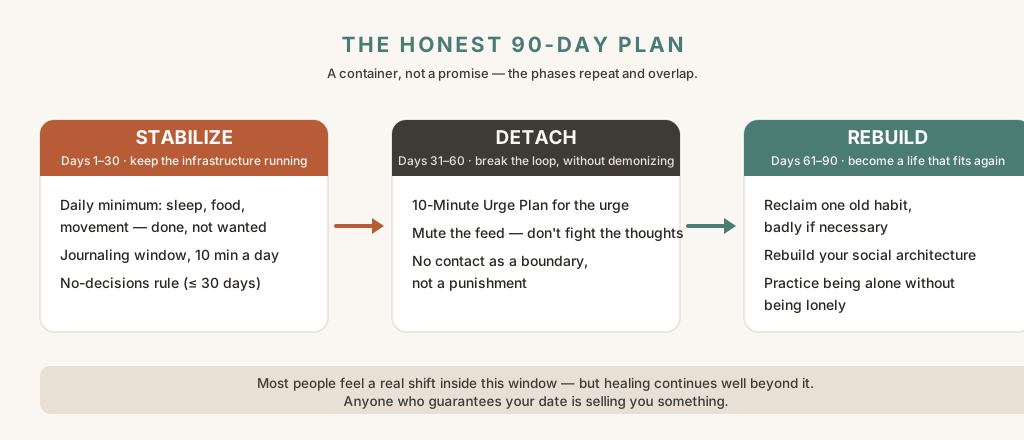
The daily minimum. Sleep at roughly the same time. Eat at roughly the same time. Move your body once a day. This isn't wellness content — it's load-bearing. Depression and grief do their worst when your body has no rhythm to hold onto, and behavioral activation — moving and doing rewarding activities on a schedule — is among the most evidence-based treatments for depression there is [9][10]. You don't need to want to do these things. That's the point: the wanting is broken right now, and the doing isn't.
Where to put the pain. You'll need somewhere for the feelings to go, or they'll go everywhere. A daily journaling window — ten minutes, at the same time each day — gives the rumination a container. People who repeatedly described their breakup in a structured way recovered faster than those who didn't; telling the story in a contained setting speeds the integration [7]. Unstructured replaying does the opposite.
Work survival. If you can't function at full capacity, don't demand it from yourself. Keep a list of the three tasks that actually move your week forward, do those, and let the rest slide — the guilt is part of the exhaustion; don't double it.
The no-decisions rule. In the first month, make no decisions with consequences longer than a month: no moving cities, no quitting jobs, no cutting off mutual friends, no new relationship to prove a point. Tonight's feelings are not a reliable consultant for next year's life. Write this where you'll see it: Don't let tonight's feelings make next year's decisions.
7. Phase 2 — Detach without demonizing (Days 31–60)
Here's where the real work happens. Phase 2 breaks the attachment loop — without pretending your ex was a monster to do it.
The 10-Minute Urge Plan. The urge to text your ex is the single most-reported pain in breakup communities. The plan is a process for the moment, because the moment is where the loop lives:
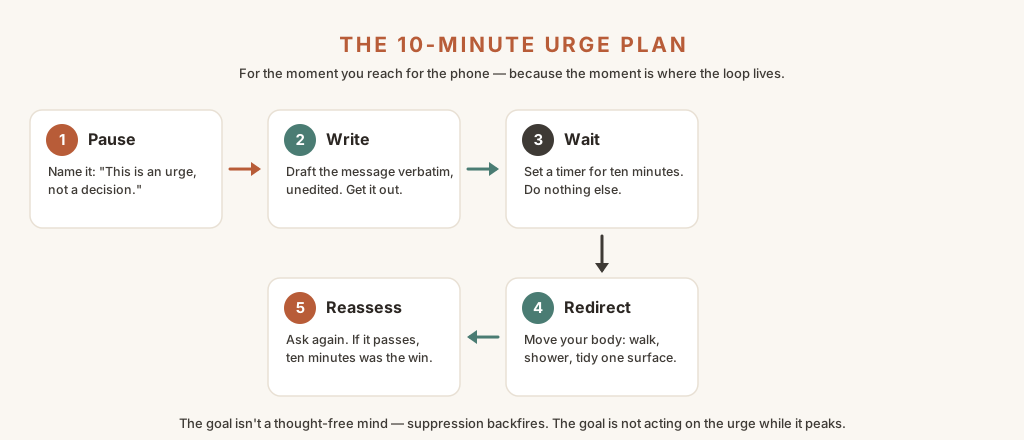
- Pause. Name it: "This is an urge — a craving spike, not a decision."
- Write. Write what you would text, verbatim, unedited — get it out of your head.
- Wait. Set a timer for ten minutes. Do nothing else. Craving peaks and fades; your only job is to not act while it's peaking.
- Redirect. Do something with your body or hands — walk, shower, cook, tidy one surface.
- Reassess. When the timer ends, ask: do I still want to send that? Often the answer is different. If it isn't, you've bought ten minutes — and ten minutes was the win.
Why suppression fails — and what to do instead. You might be tempted to make this phase about not thinking about them — bad plan. Research on thought suppression is unambiguous: the harder you try not to think of a white bear, the more you think of it — the rebound is built into the attempt [5]. The goal isn't a thought-free mind; it's a different relationship to the thoughts — which is the whole subject of our guide on how to stop thinking about your ex.
No contact, reframed. The evidence is on your side for a no-contact window [3][4], — but the framing matters. No contact isn't a punishment you inflict on your ex, and not a tactic to make them miss you. It's a boundary you set for your own recovery — you're doing it for the person you're becoming, not to them.
Digital cleanup. Mute, don't necessarily delete — a forced deletion can feel like another loss — but get them out of your passive feed. The online-monitoring effect is strongest for intentional checking; the passive drip of their face is a smaller but real cost [4]. Unfollow or mute; revisit the decision in ninety days.
8. Phase 3 — Rebuild (Days 61–90)
The attachment is quieter now, and the real question surfaces: who am I, without them? This is the phase most advice skips entirely, because it's the hardest to sell. The full evidence and system for that question lives in our guide to rebuilding your identity after a breakup.
Identity loss after a breakup isn't just a feeling — it's a measurable change. Recalling a breakup reduces people's clarity about their own identity, and the bigger the drop, the more distress follows [6]. That's why "find yourself again" is the most common desired outcome in breakup forums, and why it feels so abstract: you're not looking for a lost object — you're building a new one.
Three practices for the rebuild:
1. Reclaim the ordinary. List the things you used to do before this relationship — the hobbies, the rhythms, the way you spent a Saturday — and start doing one of them, badly if necessary. You don't need to be good at it; you need to be doing it.
2. Rebuild the social architecture. Couples lose friends in a breakup, not just partners. Text the people you haven't texted. Accept the invitations you'd normally decline. Loneliness is real and not a character flaw, but it is a problem with a practical solution.
3. Practice being alone without being lonely. The hardest and most important one. Schedule your evenings instead of hoping they'll fill themselves. Go somewhere alone — a café, a walk, a class — not to meet anyone, just to be a person in the world who doesn't need to be accompanied. This is the skill that changes everything: not needing someone to come home to, as a fact rather than a resignation.
9. How to accept that the relationship is over
Acceptance gets treated like a moment — the day you finally accept it. It isn't. It's a practice in small installments until you notice you've stopped needing to do it.
Research supports this: adjustment isn't a one-way street [8]. You'll accept it on Tuesday and feel gutted by Thursday — and that's not regression. Each cycle is a little different; the oscillation gets wider, then shallower, then it stops being the center of your life.
One thought that helps when the "what if" loop gets loud: the relationship didn't fail because you didn't try hard enough. It ended because the shape of two lives stopped fitting. Letting go isn't giving up — it's admitting that the person you loved and the person you're becoming are on different paths now.
10. When to get professional help
Everything in this guide is structured support for everyday recovery — it is not therapy, and it is not medical advice. Some situations genuinely need more than a plan:
| Situation | What it looks like | What to do |
|---|---|---|
| Depression that doesn't lift | Heavy mood, collapsed sleep, or lost interest lasting weeks | Talk to a professional; treatment works |
| Thoughts of self-harm, or feeling unsafe | Any thought of hurting yourself | Reach out now — in the US, call or text 988 (Suicide & Crisis Lifeline), or contact local emergency services |
| The relationship involved abuse | Fear, control, or harm from your ex | Prioritize safety and professional support over any advice here — including no contact and rebuilding alone |
| The urge keeps running your life | You act on it repeatedly and can't stop | These tools help with moments; a therapist helps with the pattern |
Getting help isn't a failure of this plan. It's part of the plan.
FAQ
How long does it take to get over a breakup?
There is no honest single number. The 90-day plan structures three phases — stabilize, detach, rebuild — and most people feel a real shift inside that window, but healing continues beyond it. Recovery is a gradual slope shaped by how much lingering attachment you hold onto [2]. For the full research picture, see our guide to breakup timelines.
Can I get over someone I still love?
Yes — and it doesn't require you to hate them. Love fading isn't the goal; a life that feels like yours again is. You can hold the love and still stop organizing your life around it. The love quiets not because you forced it away, but because your life fills with other things again.
Should I follow no contact?
No contact is a boundary you set for your own recovery, not a punishment or a negotiation tactic. Contact with an ex — in person or on social media — is associated with slower recovery [3][4]. The framing is what makes it work: you're not doing it to them, you're doing it for yourself, and the goal isn't to never think of them — it's to break the loop of reaching out.
The honest version of moving on
Here's what none of the advice says out loud: moving on isn't a destination you arrive at. It's a set of choices you make in the moments between — the daily minimum even when you don't feel like it, the timer instead of the text, the ordinary thing done badly over the perfect plan that never starts.
The relationship mattered — that's why it hurts, and why the rebuilding is worth doing carefully. The 90 days aren't a promise you'll be healed; they're a structure for doing the work when healing feels impossible.
Start with tonight: the daily minimum, the journaling window, the timer. That's the whole trick — you don't get over a breakup in a revelation. You get over it in the ordinary hours, one at a time.
Sources
- Fisher, H. E., Brown, L. L., Aron, A., Strong, G., & Mashek, D. (2010). Reward, addiction, and emotion regulation systems associated with rejection in love. Journal of Neurophysiology. — Read directly: study summary at Rutgers
- Sbarra, D. A. (2006). Predicting the onset of emotional recovery following nonmarital relationship dissolution: Survival analyses of sadness and anger. Personality and Social Psychology Bulletin, 32(3), 298–312. — Publisher page
- O'Hara, K. L., Grinberg, A. M., Tackman, A. M., Mehl, M. R., & Sbarra, D. A. (2020). Contact with an ex-partner is associated with psychological distress after marital separation. Clinical Psychological Science. — Read directly: full text, PubMed Central
- Social media observation of ex-partners is associated with greater breakup distress, negative affect, and jealousy (2025). Computers in Human Behavior. — Publisher page
- Wegner, D. M., Schneider, D. J., Carter, S. R., & White, T. L. (1987). Paradoxical effects of thought suppression. Journal of Personality and Social Psychology. — Read directly: APA summary — "Suppressing the 'white bears'"
- Slotter, E. B., Gardner, W. L., & Finkel, E. J. (2010). Who am I without you? The influence of romantic breakup on the self-concept. Personality and Social Psychology Bulletin, 36(2), 147–160. — Publisher page; read directly: author manuscript
- Larson, G. M., & Sbarra, D. A. (2015). Participating in research on romantic breakups promotes emotional recovery via changes in self-concept clarity. Social Psychological and Personality Science. — Read directly: ScienceDaily summary
- Shulman, S., & Yonatan-Leus, R. (2024). Understanding young people's relationship breakups using the dual-processing model of coping and bereavement. Journal of Social and Personal Relationships. — Publisher page
- Ekers, D., et al. (2011). A pragmatic randomised clinical trial of behavioural activation for depressed adults. British Journal of Psychiatry. — Read directly: full text, PubMed Central
- Examining a fully automated mobile-based behavioral activation intervention for complicated grief and rumination (2024). JMIR Mental Health. — Read directly: full text
Methodology
This guide was researched on 2026-08-24 from the peer-reviewed sources listed above. Key claims were verified by reading the primary sources or their official summaries directly: the contact-and-distress finding (Source 3, full text on PubMed Central), the thought-suppression finding (Source 5, APA's own summary), and the identity-loss finding (Source 6, author manuscript). Where a claim relies on a secondary summary (Sources 4, 7, 8), it is cited as such and the underlying study is named. Market observations — community-scale demand, the recurring "breakup advice assumes your ex was a bad person" complaint, and product pricing — come from the project's validated research dossier, dated 2026-08-22. Practical tools (the 10-Minute Urge Plan, the no-decisions rule, the daily minimum) are the brand's own frameworks, drawn from that research; they are labeled as guidance, not clinical protocols.
What is not claimed: this is not therapy or medical advice; no recovery timeline is guaranteed; the 90-day structure is a container, not a promise; individual results vary. The two flow diagrams are structural illustrations of the article's own frameworks — they contain no invented quantitative data. Update schedule: research-backed claims will be re-checked and the guide refreshed at least quarterly, or when the underlying evidence changes.