
There's a specific silence that happens after you finally say it out loud. You're with a friend or alone in your kitchen, and the sentence you've carried for weeks gets spoken: I still love them. And the moment it's out, you brace — because you've already learned what it's supposed to mean: that you're not over it, that you're failing at recovery, that you're the only one who missed the memo.
This article is about the gap between what that sentence is supposed to mean and what it actually means. The honest version is stranger and more useful than the internet's: still loving someone after a breakup is the norm, not a failure, and it is not the same thing as being stuck. Telling them apart changes what you do next.
Here's the short version, and the rest of this article unpacks it: wanting them back is ordinary, it is not driven by how much you love them, love and recovery run on different clocks, and part of "I want them back" is usually "I want myself back."
Key takeaways
- Lingering feelings are the single most common reason people get back together with an ex — the norm, not a personal failure [1]. Roughly 45% of young adults report at least one reconciliation [2].
- What predicts going back is not love, and it's not time — it's uncertainty about what the breakup meant, and not having dated others [1].
- Love and recovery run on two clocks. Acute distress lifts in weeks to months [5]; the attachment bond fades over years [4].
- The ache is proportional to what you invested, and says nothing about whether going back is right [3].
- Part of the desire to rekindle can be powered by losing your sense of self in the relationship — "wanting them back" and "wanting yourself back" get tangled [6].
- The pattern of going back carries real risk: cycling couples report lower commitment and satisfaction and more distress [7]. The question isn't only "do I still love them?" — it's "what would the pattern be?"
In this guide
- 1. Why wanting them back is ordinary
- 2. "I miss my ex" — why missing them isn't needing them
- 3. How to stop missing someone
- 4. Why the ache is so loud: investment and loss
- 5. The two clocks: love is not the same as stuck
- 6. The honest look at going back
- 7. When "wanting them back" is really "wanting yourself back"
- 8. What to actually do
- FAQ
- Conclusion: the honest version
1. Why wanting them back is ordinary
Let's start with the number that takes the shame out of the room. Researchers asked 274 people who'd been through a breakup-and-reconciliation why they renewed. The most common answer, by far, was lingering feelings — they still had feelings for their partner or still missed them [1]. Not a small study, not a marginal finding — the dominant answer in the data.
The other reasons are equally unglamorous and human: they felt their partner was "the one," they missed the companionship, they wanted the familiarity back [1]. Nobody renewed because they were weak-willed or broken. They renewed because the relationship left a residue — and that residue is what "still loving them" mostly is.
Then there's the wider picture. Roughly 45% of young adults report at least one breakup-and-reconciliation [2]. If you still love your ex, you are not the exception to the rules of recovery — you are the population. The phrase "I should be over this by now" is aimed at a person who barely exists.
One more piece: the pull back is shaped by which side of the breakup you were on. In research on breakup costs, the rejected partner more often wanted to maintain the relationship, and the two roles deploy different coping strategies [8].
2. "I miss my ex" — why missing them isn't needing them
If you've typed I miss my ex into a search bar, you already know the sentence is doing something strange. It feels like a statement about them. It's usually a statement about you.
Missing someone is not the same as needing them, and it isn't evidence that the breakup was a mistake. It's the predictable output of an attachment bond that hasn't finished updating — the same system that made their name light up your nervous system for years is still running, and it hasn't been told the ending. That's why the ache arrives without a trigger, and why it can be loudest three weeks in, when the acute shock has passed and the absence has room to be felt.
Two distinctions do most of the work here.
Missing the person vs. missing the relationship. Researchers who study why people renew breakups found that feeling "the partner was the one" and missing the companionship were separate motivations, often tangled [1]. When you say I miss her or I miss him, it's worth asking which of those you mean. Missing the company, the routine, and the shared calendar is grief for a structure you lived inside — and that structure can be rebuilt elsewhere. Missing this specific person is the narrower, harder claim.
Missing them vs. missing yourself. Part of what you're calling missing them can be missing the version of you that existed inside the relationship [6] — an ache that can't be solved by getting them back, because they aren't what you lost. Section 7 covers the research behind that.
None of this is a reason to judge yourself for the feeling — it's a reason to stop treating the feeling as a verdict.
3. How to stop missing someone
There's no switch, and anyone offering one is selling something. But the answer to how to stop missing someone is more specific than "give it time" — time alone doesn't do it; what you do during the time does.
Stop rehearsing, start interrupting. The research on unwanted relationship thoughts is unusually practical: pushing a thought away tends to make it stronger, but replacing it with a competing thought works better [9]. So when the loop starts, don't argue with it. Redirect to a specific, absorbing, boring task. Specific is the operative word — "distract myself" fails, "texts to reply to, then a shower, then bed" works.
Watch passive exposure, not just contact. This is where most people accidentally undo their own progress. Seeing their life isn't neutral — the study on Facebook surveillance of former partners found it predicted more distress and less recovery, even when you never speak to them [11]. If you're missing them intensely while still checking their profile, those two facts are not a coincidence.
Name the clock you're on. Acute pain lifts in weeks to months for most people [5]; the underlying bond fades far more slowly, with a half-life around four years [4]. Knowing which clock is running stops still missing them from feeling like failure. Missing someone at six months is on schedule. Missing them at six weeks while functioning normally is also on schedule.
Don't wait for the feeling to end before living. Postponing your life until you stop missing them inverts the mechanism: the missing fades as a side effect of building days that don't have a hole in them.
4. Why the ache is so loud: investment and loss
If wanting them back is ordinary, why does it feel so much bigger? Because you're not just mourning a person — you're mourning an investment.
The research on unmarried couples who broke up found a real, measurable hit: more psychological distress and lower life satisfaction, with the rejected partner often hit harder [3][8]. That's the proportional-ache finding, and it cuts both ways — wanting the breakup yourself did not meaningfully spare you the distress [3].
Prefer to read it first? See what's inside the guide.
5. The two clocks: love is not the same as stuck
Here's the reframe that changes the question. After a breakup, two different processes run at the same time, on completely different schedules [4][5].
The first is the acute clock: the phase where the breakup is an open wound — you can't sleep, you re-read messages, you feel it in your chest, and it's hard to imagine feeling normal. This is the distress studies measure, and it declines: separation distress in one longitudinal study fell steadily across five months (30.42 → 24.15 → 20.69) [5]. For most people, the acute phase is weeks to months, not years.
The second is the attachment clock: the bond itself, the sense that this person is still "yours" in some quiet background way. It does not run on the acute clock's schedule. Research modeling the attachment bond to an ex found a half-life of about four years [4]. You can be fully recovered — working, laughing, dating — and still feel the bond in a quiet moment. That is not being stuck. That is a bond doing what bonds do: fading slowly.
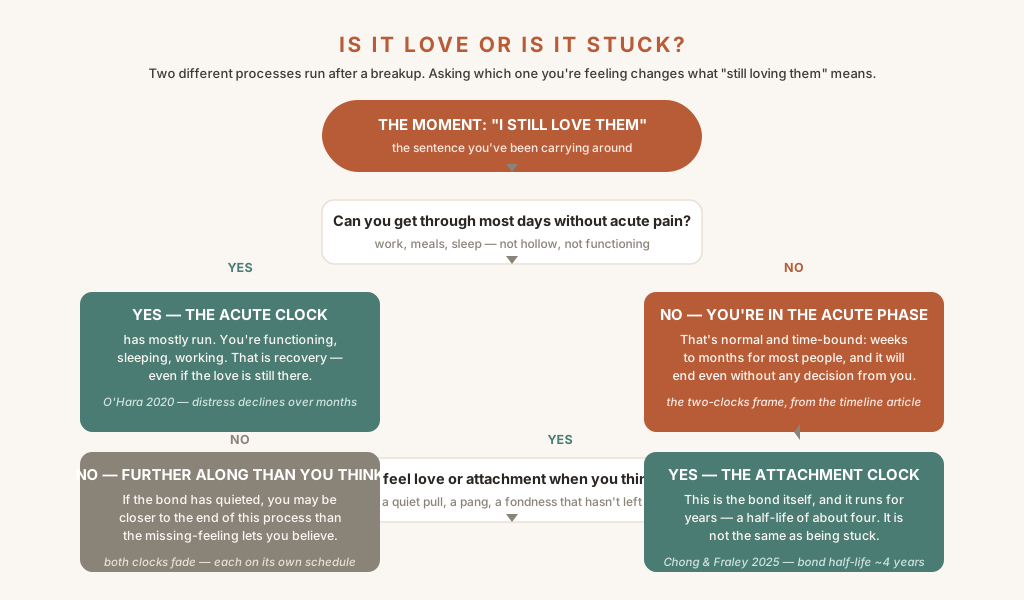
The practical value: "am I over them?" becomes two questions — "am I still in the acute phase?" and "is the bond still attached?" They have different answers and different timelines, and only one is about effort. The timeline article works through both.
6. The honest look at going back
So wanting them back is ordinary, and loving them isn't the same as being stuck. Now the honest part: "still love them" and "get back together" are different questions entirely.
The decision to go back is not driven by love. What predicts a renewal is uncertainty about what the breakup meant, and not having dated other people [1] — not the strength of your feelings.
There's a second finding that belongs in the same conversation. Researchers who study relationship cycling — breaking up and getting back together — find that cycling couples report lower commitment and satisfaction, poorer communication, and more distress than stable couples [7]. They also find more uncertainty, and higher rates of verbal abuse and physical violence [7]. That's not a statement about any one couple. It's a statement about the pattern: on average, the loop is harder than either staying or leaving.
And here's where the research and the feeling separate. The desire to go back is powered by love, loss, and familiarity — all of it real. The decision to go back should be powered by something the studies can measure: whether the two of you have a workable relationship, not whether the loss is painful. If the only reason to go back is that the loss is painful, you're not deciding to reunite; you're deciding to stop the pain — and that tends to restart the loop [7].
None of this is a verdict on your ex, by the way. The no-villain rule applies here more than anywhere: the relationship didn't end because someone was a monster. It ended because the fit wasn't working — and the fit doesn't magically change because the missing-feeling is loud. (For the boundary piece — contact, checking, the 1am urge — the no-contact article covers what feeds the loop.)
7. When "wanting them back" is really "wanting yourself back"
The desire to rekindle is predicted by post-dissolution self-concept confusion — strong overlap between your sense of self and the relationship [6].
What that means in plain language: a relationship doesn't just end the partnership. It also ends, partly, the you that existed inside it — the self that was "us": the person who texted them the funny thing, whose weekends had a shape, who was known. When the relationship ends, that self is suddenly unanchored, and one of the ways people try to re-anchor is to rekindle: if I get them back, I get that version of me back [6].
Sit with that, because it's the sentence this article has been building toward. Part of "I still love them" is love. But part of it — sometimes the loudest part — is grief for a self you can't get back by getting them back. The person who broke up with you can't return the version of you that existed before they left, because that version was built with them, not waiting for them.
This is why "just get back together" is seductive and hollow: it promises to solve the confusion by removing its cause, but the self-concept work can't be outsourced to a reunion. It has to be rebuilt by you, on your own clock — no amount of going back accelerates it. (The 90-day plan's later phases and the timeline article's two-clocks frame are the roadmap for it.) The love and the confusion are both real, and they need different responses.
8. What to actually do
Here's what the evidence actually points to.
Name which clock you're on. Use the two-clocks test: can't sleep, eat, or function is the acute clock — weeks to months, and it ends [5]. Functional but still feeling the bond is the years clock, compatible with a full life [4]. The calculator walks through it in two minutes.
Resolve the uncertainty — that's the real decision. Uncertainty about the breakup is what predicts going back [1]. So the honest work isn't "should I text them?" — it's "is this over, or am I keeping it ambiguous?" Ambiguity keeps the loop running. You can't always get certainty from them, but you can get it from yourself: the breakup happened. It meant the relationship, as it was, ended.
Redirect the behavior, don't debate the feeling. Pushing thoughts of a past relationship away tends to strengthen their return [9]. When the urge hits — the drafted message, the profile check — use an if-then plan made in advance ("when I want to text them, I will text my friend instead"), and make the substitute specific: calling Dana outperforms "distracting myself" [10].
Watch the exposure, not just the contact. Contact slows recovery, and passively watching their life is associated with more distress, more longing, and less personal growth [11]. Muting isn't punishment; it's changing your own feed so the wound can close. (The no-contact article has the full evidence.)
Make the question about the pattern, not the pain. Evaluate the relationship that would exist, not the one you're missing. Write down the honest reasons it ended and re-read them when the missing gets loud — "I don't know" is the exact uncertainty that keeps people cycling [1][7].
Get help if the acute clock runs long. If the distress isn't lifting — deep pain at six months to a year, or a life that's stopped functioning — that's not a willpower shortage or a sign the love was "meant to be." It's a sign you need support from someone trained for it [12]. No article, including this one, replaces that. (If you're in crisis, the helpline numbers are at the end of this page.)
FAQ
Is it normal to still love your ex?
Yes — it's the norm, not the exception. Lingering feelings were the most common reason cited for getting back together in one study [1], and roughly 45% of young adults report at least one reconciliation [2]. Still loving someone after a breakup is ordinary; what matters is what you do with the feeling.
How do I know if I'm over my ex or just still attached?
Ask which clock you're on. If you get through your days — work, meals, sleep — without acute pain, the acute phase has mostly run. If you still feel love when you think of them, that's the attachment bond, which fades over years, not months [4][5]. Functional while still loving them is the slow fade, not being stuck. The breakup timeline calculator shows which clock you're on — and if the thoughts are hijacking your attention, our guide on how to stop thinking about your ex walks through what actually interrupts the loop.
Does still loving them mean I should get back together?
No. What predicts going back is uncertainty about what the breakup meant, not how much you love them [1] — and the pattern of cycling carries real risk: lower commitment and satisfaction, more distress [7]. The honest question isn't "do I still love them?" but "would the relationship actually work?"
Why do I miss my ex so much — and why do I still want them back?
Usually three things at once: genuine attachment, the proportional ache of losing a real investment [3], and — often the loudest — grief for the version of you that existed inside the relationship [6]. In the study of why people renew breakups, lingering feelings and missing the companionship were the dominant motivations, and they were distinct from each other [1]. Research also finds post-breakup self-concept confusion predicts rekindling desire, especially for the anxiously attached [6]. Wanting them back and missing them get mixed up; untangling them is part of the work. Missing them intensely doesn't tell you the breakup was wrong. It tells you the bond was real.
How long does the missing last?
Longer than the acute pain, shorter than the bond. Acute distress lifts in weeks to months for most people [5], while the attachment bond fades on a much slower clock — a half-life of about four years [4]. In practice that means the sharp, constant missing usually eases within months, and occasional missing can surface for years without meaning anything is wrong with your recovery.
Will the missing ever go away?
It fades, on its own clock — and the goal isn't a day where you feel nothing, it's a day where the love doesn't run your decisions.
What if I was the one who ended it and I still love them?
Wanting the breakup doesn't spare you the pain — a desire to break up wasn't associated with smaller increases in distress [3]. The cost of caring still comes due. You can have ended the relationship and still be in the slow fade. What doesn't work is re-opening it out of guilt or loneliness; that's how the cycle restarts [7].
Conclusion: the honest version
Here's what "I still love them" turns out to be. Not a failure of recovery, not a sign you should go back, and not evidence you're the one who couldn't do the work. It's the ordinary residue of a bond that mattered, fading on its own clock while you rebuild the rest. You don't have to stop loving them to recover — you have to stop letting the love make the decision.
Sources
- Dailey, R. M., Jin, B., Pfiester, A., & Beck, G. (2012). On-again/off-again dating relationships: What keeps partners coming back? Journal of Social and Personal Relationships. — Full-text PDF — N=274; lingering feelings the most common reason for renewals; renewals predicted by uncertainty about the breakup's meaning, not dating others, and feeling the on-off nature improved the relationship. Read directly 2026-08-25.
- Halpern-Meekin, S., Manning, W. D., Giordano, P. C., & Longmore, M. A. Relationship churning in emerging adulthood. — Full text, PubMed Central — ~45% of young adults report at least one reconciliation; average ~2.4 disruptions among those who reconciled. Read directly during our 3-week-rule production.
- Rhoades, G. K., Dush, C. M. K., Atkins, D. C., Stanley, S. M., & Markman, H. J. (2011). Breaking up is hard to do: The impact of unmarried relationship break-up on psychological distress and life satisfaction. Journal of Family Psychology, 25(3), 366–374. — Full text, PubMed Central — breakup associated with higher distress and lower life satisfaction vs staying; characteristics (incl. desire to break up) related to life-satisfaction change but not distress change; longer dating → more distress. Read directly 2026-08-25.
- Chong, S. C., & Fraley, R. C. (2025). The attachment bond to an ex-partner: A half-life model. Social Psychological and Personality Science. — Attachment bond half-life ~4 years (midpoint 4.18 years); contact → bond can persist a decade or more. Abstract + authors' summary read directly during our timeline article production.
- O'Hara, K. L., et al. (2020). Contact with an ex-partner is associated with psychological distress after marital separation. Clinical Psychological Science. — Full text, PubMed Central — separation distress declined 30.42 → 24.15 → 20.69 across five months; contact predicted higher distress two months later. Read directly during our timeline article production.
- Cope, M. A., & Mattingly, B. A. (2021). Putting me back together by getting back together: Post-dissolution self-concept confusion predicts rekindling desire among anxiously attached individuals. Journal of Social and Personal Relationships, 38(1), 384–392. — DOI page — attachment anxiety predicts rekindling desire mediated by self-concept clarity/confusion; romantic dissolution diminishes self-concept clarity. Abstract-level (SAGE paywall) — the claim is characterized at abstract level, no invented numbers.
- Vennum, A., et al. (2014). Relationship cycling and outcomes. Journal of Social and Personal Relationships, 31(3), 410–430. — Full-text PDF — cycling associated with lower commitment and satisfaction, poorer communication, more uncertainty, higher verbal abuse and violence rates vs stable couples; ~30–50% of young adults report at least one breakup-reconciliation. Read directly 2026-08-25.
- Perilloux, C., & Buss, D. M. (2008). Breaking up romantic relationships: Costs experienced and coping strategies deployed. Evolutionary Psychology, 6(1), 164–181. — DOI page — rejectees more often report a desire to maintain the relationship; costs and coping differ by gender and role; women endorsed more negative affect regardless of initiation status. Abstract-level (SAGE paywall) with secondary corroboration — characterized at that level, no invented numbers.
- Wegner, D. M., & Gold, D. B. (1995). Fanning old flames: Emotional and cognitive effects of suppressing thoughts of a past relationship. Journal of Personality and Social Psychology, 68(5), 782–792. — PubMed — suppressing thoughts of an old flame can strengthen their return. Verified during our no-contact-rule production; abstract read directly.
- Gollwitzer, P. M., & Sheeran, P. (2006). Implementation intentions and goal achievement: A meta-analysis. Advances in Experimental Social Psychology, 38, 69–119. — PMC overview — d = 0.65, 94 tests, 8,000+ participants; stop-behavior plans need specific substitute actions. Read directly during our no-contact-rule production.
- Marshall, T. C. (2012). Facebook surveillance of former romantic partners. Cyberpsychology, Behavior, and Social Networking, 15(10), 521–526. — Full text, PubMed Central — surveillance associated with greater distress, longing, lower personal growth; Marshall, T. C. (2025). Computers in Human Behavior, 176, 108869 — active and passive observation predict same-day/next-day distress; authors recommend unfriending/unfollowing/muting. Both read directly during our no-contact-rule production.
- Seraj, S., Blackburn, K. G., & Pennebaker, J. W. (2021). Language left behind on social media exposes the emotional and cognitive costs of a romantic breakup. PNAS. — Language patterns normalize ~6 months; deep distress at 6 months–1 year → professional help. Authors' summary read directly during our timeline article production.
Methodology
How this was compiled. This article was researched and written on 2026-08-25. The core claims were verified against primary sources read directly on that date: the Rhoades et al. 2011 full text (PMC3115386), the Dailey et al. 2012 full-text PDF (on-again/off-again renewals), and the Vennum et al. 2014 full-text PDF (relationship cycling). The Cope & Mattingly 2021 and Perilloux & Buss 2008 findings sit behind SAGE paywalls; we read the published abstracts and corroborating secondary sources, and the article characterizes those claims at abstract level with no invented statistics. The two-clocks, contact, suppression, implementation-intentions, language-signature, and reconciliation-rate claims (Sources 2, 4, 5, 9, 10, 11, 12) reuse evidence verified against primary sources during the production of our earlier timeline, 3-week-rule, and no-contact articles, cross-checked against the evidence ledger (E12–E25, E29–E34, E82–E83, E87–E88 reused; E90–E99 new).
What is not claimed. We are not claiming everyone should get back together or that no one should — the research shows the pattern of cycling carries risk, but individual relationships vary, and no study can rule on a specific couple. We are not claiming the desire to rekindle is "just" self-concept confusion — the finding is that self-concept confusion predicts rekindling desire, especially for anxiously attached people; it is partial, not exclusive. We are not claiming the ex was the problem or the villain — this article deliberately avoids demonizing either party; the fit ended, and the missing-feeling is the cost of having cared. We are not claiming contact causes slow recovery in a strict causal sense — the contact and surveillance studies are largely observational. We are not claiming the four-year attachment half-life means four years of pain — acute distress lifts on a separate, faster clock; the half-life describes the background bond. No first-hand clinical experience is claimed; the author is an editorial lead, not a therapist. If you are in crisis or considering self-harm, call or text 988 (US) or your local emergency service.
Update schedule. Reviewed monthly against the cited research, consistent with the site's freshness policy for recovery content.